Page contents
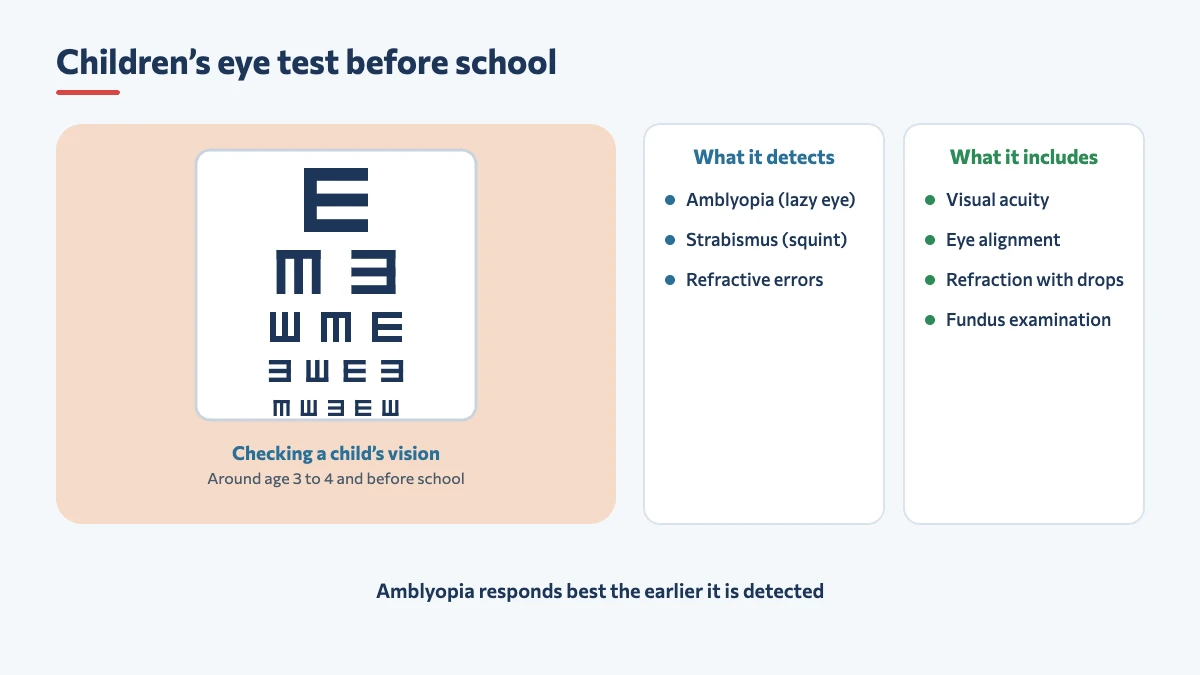
A children’s eye test before school, ideally between the ages of 3 and 5, picks up problems such as amblyopia (so-called lazy eye), strabismus (squint) and refractive errors at an early stage. Many of these give no obvious signs, yet they are treated far more effectively while the child’s visual system is still developing.
Why does an eye check before school matter so much?
Vision is not “ready” at birth. The brain learns to see during the first years of life, based on the clear images it receives from both eyes. If one eye sends a blurred image or is not properly aligned, the brain starts to ignore it. The younger the child, the more adaptable this system is and the better it responds to treatment.
Children rarely complain. A child who sees well with one eye and poorly with the other has nothing to compare it with and assumes this is how everyone sees. That is why many problems are only discovered through an examination. In addition, visual demands rise sharply at school: reading, the board and hours of close work. An uncorrected refractive error can show up as tiredness, inattention or learning difficulties and be misinterpreted.
What does the eye test detect?
Amblyopia
Amblyopia is reduced vision in one eye, or less often both, without any visible damage to the structure of the eye. It affects about 2 to 3 in every 100 children. The most common causes are strabismus and a large difference in prescription between the two eyes. When diagnosed early, it is usually treated with glasses and by patching the good eye for a few hours a day, or with drops that temporarily blur the good eye, so that the weaker eye is made to “work”. Treatment is most effective before about the age of 7, although some children still improve later.
Strabismus (squint)
In strabismus the eyes do not point in the same direction. It can be constant or appear only when the child is tired, unwell or looking at something close up. Beyond appearance, it affects depth perception and can lead to amblyopia. Some forms, especially those linked to long-sightedness, improve significantly with glasses alone, while others need surgical correction.
Refractive errors
Hyperopia (long-sightedness) is common in young children and, to a small degree, is considered normal. When it is high, it tires the child during close work and can cause a squint. Astigmatism blurs the image at all distances. Myopia in children usually appears at school age and tends to increase as the child grows. Early diagnosis makes it possible to discuss measures that slow its progression, such as special lenses or low-dose drops, always under medical supervision.
Other findings that may come to light
Less often, the examination reveals conditions unrelated to refraction: a drooping upper eyelid that covers the pupil, congenital cataract, problems with the optic nerve or retina, as well as chronic blepharitis or allergic conjunctivitis that bother the child every day. Detecting these early is just as important, because some need prompt treatment so that visual development is not affected.
What does the examination involve?
A paediatric eye examination is adapted to the child’s age and takes longer than a simple vision check. It usually includes:
- History: pregnancy, birth, developmental milestones, and any family history of squint, amblyopia or high refractive errors.
- Visual acuity in each eye separately, using picture or symbol charts for children who cannot read yet.
- Eye movement and alignment, assessed with the cover test.
- Stereoscopic vision, in other words depth perception, using special pictures and glasses.
- Cycloplegic refraction: using drops that temporarily relax focusing, we measure the true prescription. Without them, long-sightedness in children is often “hidden”.
- Fundoscopy, to examine the retina and the optic nerve.
The drops dilate the pupils, and your child may have blurred near vision and sensitivity to light for a few hours, less often until the next day. It is best to schedule the appointment so that no demanding activity follows, and to bring a hat or sunglasses. You can find more about what to expect on our paediatric ophthalmology page.
How to prepare your child
Explain in simple words that they will look at pictures, wear some “magic” glasses and have drops put in that sting for a moment. Choose a time when your child is well rested, bring a favourite toy or snack and, if they already wear glasses, bring them along. Make a note of anything you have noticed at home, as this helps the doctor a great deal.
What happens after the examination?
If everything is normal, the next check is arranged. If glasses are needed, the doctor explains when your child should wear them and when the follow-up will be, usually after a few weeks or months, to see how they respond. In amblyopia, treatment needs the cooperation of the whole family and of the nursery or school, so that the child wears glasses and an eye patch consistently without feeling uncomfortable.
When should eye checks take place?
| Age | What is recommended |
|---|---|
| Newborn and first months | Check by the paediatrician (red reflex, following the child’s gaze) |
| 6-12 months | Eye assessment if there are warning signs or a family history |
| 3-4 years | First full eye examination |
| 5-6 years, before starting primary school | Repeat check before school begins |
| School age | Regular check, usually every 1-2 years or as the doctor advises |
These intervals are a guide and are adjusted for each child. You will find the schedule in detail in our article on when a paediatric eye examination is recommended.
When to see an ophthalmologist sooner
Do not wait for the scheduled check if you notice:
- An eye that “wanders” inwards or outwards, even occasionally.
- Head tilting or turning to look at something.
- Squinting, or closing one eye in bright light or to see better.
- Sitting very close to the television, a book or a screen.
- Frequent eye rubbing, watery eyes or headaches after reading.
- Difficulty concentrating or reading that cannot be explained otherwise.
- A white reflection in the pupil in flash photos instead of the usual red. This needs an examination without delay.
How to support your child’s vision at home
Time spent outdoors in natural light has been associated with a lower risk of developing myopia, which is why about two hours of outdoor activity a day is recommended. For close work and screens, regular breaks and good lighting help. If your child needs glasses, wearing them consistently as the doctor advised is part of the treatment, not an option. Stay in touch with teachers too, as they are often the first to notice that a child is struggling to see the board.
To have your child’s eyes checked before they start school, book an appointment at our clinic in Neo Psychiko, Athens.
Frequently Asked Questions
The paediatrician has checked my child’s vision. Do we also need an ophthalmologist?
The paediatrician’s check is valuable, but it is a screening test and does not pick up every problem. Long-sightedness, mild astigmatism or a difference in prescription between the two eyes often only show up with cycloplegic refraction. A full eye examination before school complements the paediatric follow-up; it does not replace it.
Can a child who cannot read yet have an eye test?
Yes. For young children we use charts with pictures, shapes or symbols that the child names, matches or points to. In addition, measuring the prescription with drops and examining the back of the eye do not require reading or much cooperation. This means the ophthalmologist can get a reliable picture even in a three-year-old.
If my child needs glasses, will they have to wear them for ever?
Not necessarily. Long-sightedness often decreases as the child grows, and in some children with amblyopia glasses are needed mainly during the years of treatment. Myopia, on the other hand, tends to increase during the school years. Regular follow-up shows when the prescription changes or when glasses are no longer needed.
Are dilating eye drops safe for children?
Cycloplegic drops are widely used in paediatric ophthalmology and are considered safe. They may sting for a few seconds and cause blurred near vision and sensitivity to light for a few hours. Occasionally, temporary facial flushing occurs. If your child has a health condition or allergies, tell the doctor before the examination.
Questions about your case?
Dr. Skouteris will examine you at his practice in Neo Psychiko and explain your options.

Ophthalmic surgeon trained at the John Radcliffe University Hospital in Oxford and Fellow of the European Board of Ophthalmology (FEBO).
Full profileRelated articles
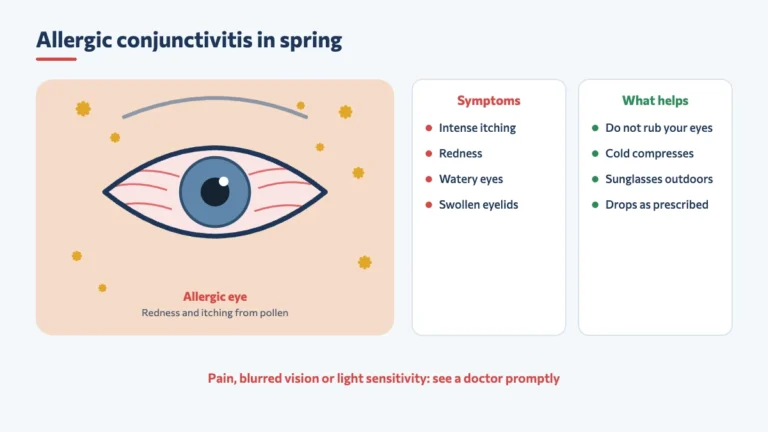
Allergic Conjunctivitis in Spring: Symptoms, Prevention and When to Worry
Itching, redness and watering in both eyes every spring? How to recognise allergic conjunctivitis, what helps prevent it and which signs need prompt examination.
Read the article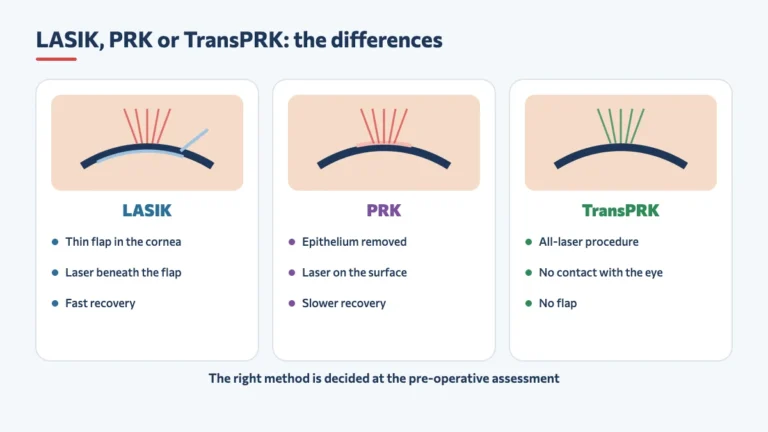
LASIK, PRK or TransPRK: Which Laser Eye Surgery Is Right for You?
The difference between LASIK, PRK and TransPRK, how long recovery takes and which criteria determine the right laser eye surgery for each eye.
Read the article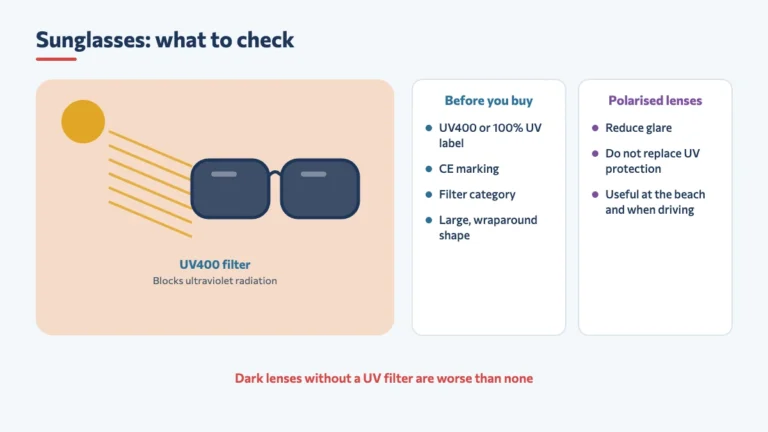
Sunglasses and Eye Protection: What to Check Before You Buy (Including for Children)
UV400, CE mark, filter category and polarised lenses: what to check before buying sunglasses for yourself and for your children.
Read the article