
What is myopia?
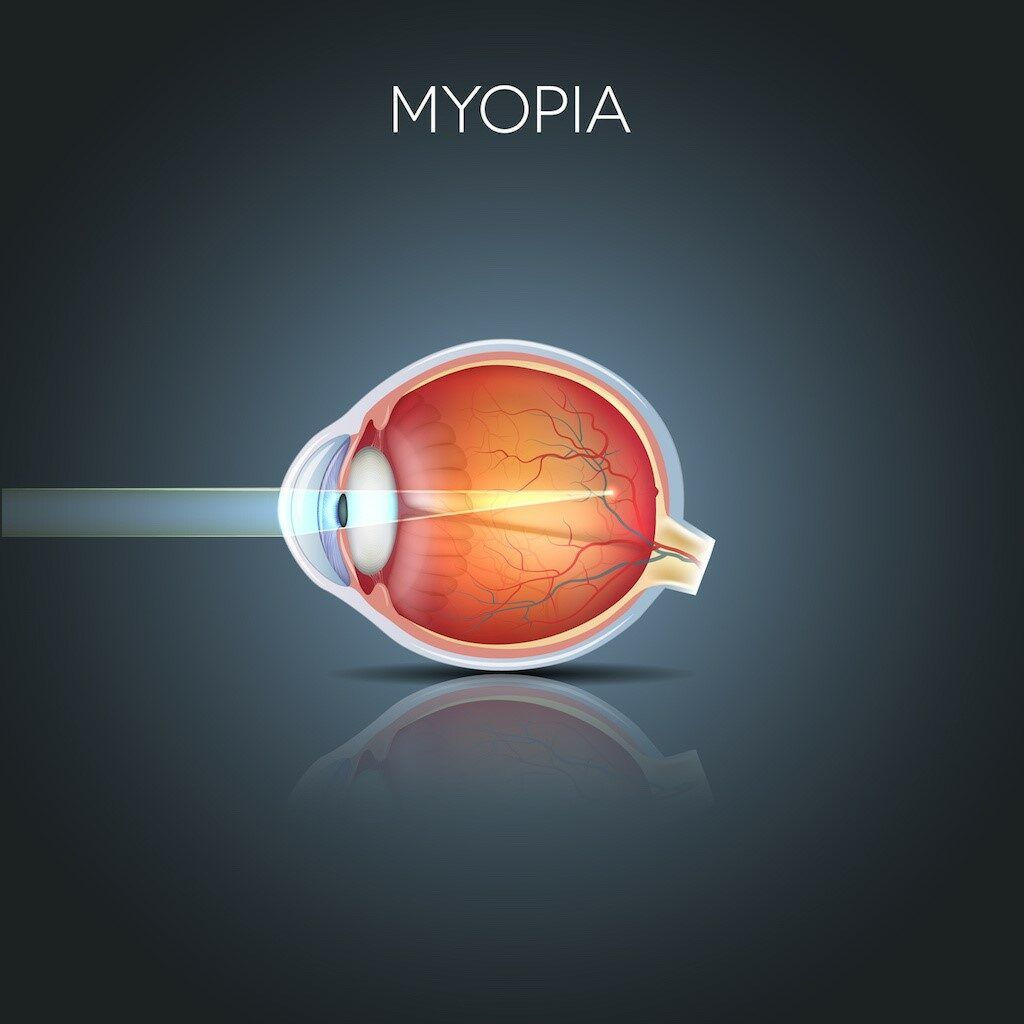
Myopia (short-sightedness) is a condition that causes blurred vision, mainly for objects in the distance, and today it can be corrected permanently with myopia laser treatment. The main job of the eye is to focus all the rays of light onto the retina. In other words, it works like a converging lens through which light passes, and all its rays are focused on the back part of the eye, called the retina, whose job is to turn light into an image. In myopia, the light rays do not focus exactly on the retina but in front of it, so they cross over and create blurred vision. The reason the rays do not focus properly is, in most cases, the length of the eye, which in myopia is longer than average. In the second and much rarer case, it has to do with the focusing power of the cornea and the lens, which in myopia is also greater than average.
Page contents
- What is myopia?
- How is myopia corrected?
- Myopia laser treatment: is it really such a simple procedure?
- LASIK, PRK and TransPRK at a glance
- How can we know which of the two procedures is right for us?
- What is the right age for corrective laser eye surgery?
- How long does corrective laser eye surgery take?
- How safe is this procedure?
- What is the exact cost of this procedure? Are the prices affordable?
- Why myopia develops
- Myopia in children: can we slow it down?
- High myopia: why regular check-ups are needed
- Signs that need an urgent examination
- Phakic intraocular lenses for very high myopia
- How a person with myopia sees
- Glasses or contact lenses?
- Frequently Asked Questions about Myopia and Laser Treatment
How is myopia corrected?
The aim of correcting myopia is to change the path of the light rays and focus them where they should be. This is done with diverging (minus) lenses, that is, lenses that spread the light rays apart. These lenses can be in contact with the cornea, in which case they are called contact lenses, or fitted in a spectacle frame. In recent years it has also been possible to correct myopia permanently, with what most people know as myopia laser treatment.
Book an appointment with the doctor
An examination and clear advice on your case at our practice in Neo Psychiko.
Myopia laser treatment: is it really such a simple procedure?
We have all heard of the procedure that can rid us of our myopia, as well as astigmatism or hyperopia, in just a few seconds.
But how much do we really know about this procedure?
The first and most important question is whether the procedure is painful. The short answer is very little or not at all. But to put things in order, it is useful to know what types of procedures exist for correcting these refractive errors, as myopia, hyperopia and astigmatism are called.
The two most widely used types of procedure are LASIK and PRK. Both procedures have excellent results and provide equally good vision as the final outcome.
So what are the differences between them?
In PRK we change the shape of the cornea at its surface, that is, on the outer surface of the cornea, by creating a small opening in its top layer, which heals within the first two to three days. This is also the period in which vision returns to 95% of normal, while 100% returns after the first week.
This method is used in people whose corneal thickness is below average, and the reason has to do with safety. After PRK, for the first one to two days, there may be some mild discomfort and a tendency to keep the eyes closed. This settles very quickly and is due to the small opening we have created on the outer surface of the cornea in order to change its shape and correct the myopia. The second method is called LASIK, and it is the method preferred by most ophthalmologists as well as patients. The reason is that vision returns to 95-100% from the morning after the procedure, while discomfort is minimal or absent.
The very fast recovery of vision, together with the fact that it is completely painless, makes LASIK particularly popular. This is because the change in the shape of the cornea is not made at the surface but at about one fifth of its thickness. Of course, to be able to carry out a procedure with this method, the cornea must have a normal shape and sufficient thickness.
LASIK, PRK and TransPRK at a glance
All three techniques change the curvature of the cornea with an excimer laser. The difference lies in how the cornea is accessed, which affects recovery and suitability for each eye.
| Feature | LASIK | PRK | TransPRK |
|---|---|---|---|
| How it is done | A thin flap is created and the laser is applied underneath it | The epithelium is removed and the laser is applied to the surface of the cornea | The laser removes the epithelium and performs the correction in one step, without touching the eye |
| Discomfort afterwards | Mild, for a few hours | Pain and watering for 2-4 days | Similar to PRK, often milder |
| Functional vision | From the next day | In about 4-7 days | In about 3-5 days |
| Full stabilisation | A few weeks | Up to 1-3 months | Up to 1-3 months |
| Thin cornea | Often not suitable | May be suitable | May be suitable |
| Contact sports | Small risk of flap displacement | No flap | No flap |
When the choice is made correctly, the final visual result is similar with all three methods. The decision is based on the thickness and map of your cornea, the degree of myopia and your lifestyle. You will find details of all the techniques on the page about laser eye surgery.
How can we know which of the two procedures is right for us?
A very simple test called corneal topography, which takes just a few seconds, is enough for us to draw up a treatment plan and to advise the person who wants refractive surgery on which method is ideal for them. This is the most important part of the pre-operative assessment, and if it is done accurately it will give us a very good result. Corneal topography essentially shows us the shape of the cornea, which in some cases may be a contraindication to this corrective procedure. Another very important part of the process is the measurements of the eyes, so that we arrive at the exact prescription, which prevents the possibility of correcting too little or too much.
Book an appointment with the doctor
An examination and clear advice on your case at our practice in Neo Psychiko.
What is the right age for corrective laser eye surgery?
Myopia, hyperopia or astigmatism could be corrected at any age. However, in the case of myopia it is preferable for the procedure to take place after adulthood and once the myopia has been stable for at least two years, so that we can be sure there will be no further increase in myopia after the procedure. It is, of course, preferable to have the procedure at a young age, so that you can enjoy many years of your life without glasses at all.
An important clarification needs to be made for people with myopia in whom presbyopia has already started, as after refractive surgery they may lose the ability to read at close range by taking off their glasses. This does not mean that presbyopia is accelerated, but that they lose the convenience a person with low myopia has of lifting their glasses and reading at close range, which they cannot do while wearing their glasses. In the case of astigmatism, refractive surgery is beneficial at all ages, as astigmatism affects both distance and near vision, and especially in irregular or high astigmatism the benefit is even greater. This is because astigmatism often cannot be corrected with glasses well enough to give perfect vision. In such cases we can give the laser the individual shape of the person’s cornea so that it smooths it out completely.
Hyperopia, in most cases, appears at an older age, usually as early presbyopia. People with high, moderate and even low hyperopia will see a great improvement in their near vision, while their distance vision can become perfect without glasses. This means they will no longer depend on distance glasses for television, the cinema and so on, and their need for reading glasses will be noticeably reduced.
How long does corrective laser eye surgery take?
The laser that changes the shape of the cornea works for between five and at most 20 seconds, depending on the prescription we want to correct. The whole procedure therefore takes 10 to 15 minutes, and this has more to do with preparing the eye for the laser than with anything else. The steps from the moment you enter the treatment room are: we clean the eyelashes with an antiseptic solution, place some small plastic adhesive strips that isolate the eyelashes, and a small clip that stops you from blinking.
The laser is centred and, once all the parameters are correct, it goes ahead with correcting the myopia, hyperopia or astigmatism. Of course, the more modern the machine, the less time it needs to carry out the correction and the safer it is. The latest-generation machines can track the movements of the eye with remarkable precision and continue correcting the prescription even if the eye makes small movements. If the eye movements are large, the correction stops automatically and resumes when the eye is still again and in the right position.
Book an appointment with the doctor
An examination and clear advice on your case at our practice in Neo Psychiko.
How safe is this procedure?
As announced at the congress of the American Academy of Ophthalmology, LASIK is the safest and most effective elective procedure on the eye. It is a very well-studied procedure, and all the data show that the rates of satisfied patients and excellent vision are particularly high. The latest-generation machines add further safety and effectiveness, while many years of experience have also helped to reduce the cost of myopia laser treatment significantly.
What is the exact cost of this procedure? Are the prices affordable?
The exact price of myopia laser treatment cannot be announced because of restrictions set by the Medical Association, but we will be happy for you to contact us in whatever way you prefer (phone, personal message or email) so that we can give you detailed information about prices and costs.
Why myopia develops
In myopia the eye is slightly longer than normal or the cornea is more steeply curved, so light from distant objects focuses in front of the retina. Two groups of factors contribute to its development:
- Heredity: when one or both parents are short-sighted, the likelihood of the child developing myopia increases significantly.
- Environment and habits: long hours of close work, reading and screens, combined with little time outdoors, are linked to the increase in myopia seen worldwide in recent decades.
Myopia in children: can we slow it down?
Myopia usually appears at school age and increases as the child grows, until it stabilises at around 18 to 25 years. The earlier it starts, the higher it tends to become. Today we are not limited to correcting it with glasses. There are methods that have been proven to slow its progression:
- Time outdoors: at least two hours a day outside in natural light reduces the likelihood of developing myopia.
- Low-dose atropine eye drops: one drop in the evening, with medical monitoring, slows the increase in myopia in many children.
- Special myopia control spectacle lenses and contact lenses: designed to change the way light focuses on the periphery of the retina.
- Orthokeratology: special lenses worn only at night that temporarily reshape the cornea.
The right method is chosen after an examination with drops and often a measurement of the length of the eye. You will find more about eye examinations in children on the paediatric ophthalmology page.
Is your child's myopia increasing every year?
There are modern methods that slow its progression. Book an eye examination in Neo Psychiko, Athens.
High myopia: why regular check-ups are needed
When myopia exceeds about -6 dioptres, the eye is considerably elongated and the retina is thinner. High myopia is linked to an increased risk of:
- retinal detachment
- myopic maculopathy, that is, changes in the centre of vision
- glaucoma
- earlier cataract
Laser treatment corrects the need for glasses, but it does not change the length of the eye. That is why short-sighted people, even after laser treatment, need regular dilated examinations of the back of the eye.
Signs that need an urgent examination
If you have myopia and suddenly notice many new floaters, flashes of light at the edge of your vision or a shadow like a curtain covering part of your field of vision, you need an examination on the same day. These may be signs of a retinal tear or detachment, which is treated much more successfully when diagnosed early.
Phakic intraocular lenses for very high myopia
For very high myopia, or when the cornea is too thin for laser, there is the option of a phakic intraocular lens. This is a thin lens placed inside the eye, in front of the natural lens, without removing anything. The procedure is reversible and gives very good quality of vision. Suitability is assessed with special measurements of the anterior chamber and the corneal endothelium.
How a person with myopia sees
A short-sighted person sees near objects clearly, while distant ones look blurred. In mild myopia, the difficulty shows mainly with the board at school, road signs, television subtitles or recognising faces at a distance. Many people squint to see better, because this narrows the “aperture” and increases the depth of focus. At night myopia becomes more noticeable because the pupil dilates, and drivers with small uncorrected myopia struggle more in the dark.
Glasses or contact lenses?
Glasses are the simplest and safest solution and suit all ages. Contact lenses offer a full field of vision and are practical for sport, but they require strict hygiene. Daily disposable lenses carry the lowest risk of infection. You should never sleep in lenses, unless they have been prescribed specifically for this, or swim in them without protection. People who have worn contact lenses for many years and have started to become intolerant of them may be good candidates for laser correction.
Whether it is a child with increasing myopia or an adult who wants to be free of glasses, a full examination is the first step towards the right decision.
Frequently Asked Questions about Myopia and Laser Treatment
How can myopia be reduced?
In adults, myopia cannot be reduced with exercises or diet. It is corrected with glasses or contact lenses, while laser eye surgery or, for high prescriptions, phakic intraocular lenses offer a permanent solution. In children, the progression of myopia can be slowed with special lenses, low-dose drops and more time outdoors.
LASIK or PRK: which procedure is better for me?
Both give a similar final result when performed on a suitable eye. LASIK has a faster recovery and less discomfort, while PRK or TransPRK are preferred for a thin cornea, certain corneal irregularities and contact sports. The choice is made after a full pre-operative assessment with topography and pachymetry.
From what age can you have laser treatment for myopia?
Myopia laser treatment is usually carried out after the age of 18, once the prescription has remained stable for at least one year. In many young people myopia continues to change until 20-25, so it is worth waiting. There is no strict upper age limit, but after 45 other options are also discussed because of presbyopia.
Can myopia come back after laser treatment?
When myopia is stable before the procedure, the result of laser treatment is usually permanent. A small return of myopia can occur with high prescriptions or when the eye continues to change, and it can sometimes be corrected with an enhancement procedure. Presbyopia after 40-45 develops as normal and does not mean that myopia has returned.
Medically reviewed by: Dr. Vasileios Skouteris MD, FEBO