
Written by Vasileios Skouteris MD, FEBO, Ophthalmic Surgeon
Page contents
- What is a pinguecula?
- How common is it?
- Causes and risk factors
- Symptoms
- Pinguecula or pterygium? The differences
- What else can it look like?
- Diagnosis
- Treatment
- Prevention: how to stop it growing
- Pinguecula in young people
- What helps at home and what does not
- Monitoring: how often do you need a check-up?
- Pinguecula and contact lenses
- Pinguecula and eye surgery
- When to get examined
- Frequently Asked Questions about Pinguecula
A pinguecula is a small, yellowish bump on the white of the eye, usually on the side nearest the nose, next to the coloured part. It is a benign change in the conjunctiva caused by long-term exposure to sun, wind and dust. It is not a tumour, does not threaten your sight and in most people needs no treatment at all. It becomes bothersome when it is inflamed, making the eye red and sore, and is then treated with lubricating drops and, for a few days, anti-inflammatory drops.
What is a pinguecula?
The conjunctiva is the thin, transparent membrane that covers the white wall of the eye. Beneath its surface lies a layer of connective tissue with collagen and elastin fibres. In a pinguecula, these fibres have degenerated in a small area: they have thickened, lost their arrangement and been replaced by amorphous material, in which calcium is sometimes deposited. The result is a slightly raised patch that is yellowish or off-white in colour.
Despite its name, a pinguecula is not fat. The term comes from the Latin word for fat, because that is what it looks like to the naked eye. In reality, it is the same change that the sun causes in the skin of people who have worked outdoors for years, only here it happens in the conjunctiva. You could describe it as a “callus” of the eye caused by the sun.
Its features are consistent and make it easy to recognise:
- it sits on the white of the eye, touching or very close to the edge of the cornea, without growing onto it
- it is found in the area left uncovered when the eye is open, that is, at the 3 and 9 o’clock positions
- it is more common on the side nearest the nose, but can also be on the side nearest the temple, or on both sides
- it is triangular or oval and a few millimetres in size
- it is usually present in both eyes, though not necessarily to the same degree
- it grows very slowly, over years, or stays the same
How common is it?
It is one of the most common findings in an eye examination. Rare before the age of 20, it becomes increasingly common with age, and in sunny countries such as Greece most people over 50 or 60 have some degree of pinguecula. Many have never noticed it. They discover it when the eye becomes red for another reason and they look closely in the mirror, and then they worry that “something new has appeared”.
Book an appointment with the doctor
An examination and clear advice on your case at our practice in Neo Psychiko.
Causes and risk factors
Ultraviolet radiation
The sun is the main cause. The cumulative dose of ultraviolet radiation over a lifetime damages the fibres of the conjunctiva, in exactly the same way that skin ages. Why a pinguecula appears mainly on the side nearest the nose has an interesting explanation: light coming from the side, from the direction of the temple, passes through the cornea, which acts like a lens, and is focused on the opposite side, exactly where the cornea and conjunctiva meet next to the nose. This spot therefore receives many times more radiation. This is also why sunglasses with open sides protect less than we think.
Wind, dust and dryness
Chronic irritation from wind, dust, sand, smoke and a dry climate contributes to its formation and, above all, to its flare-ups. The part of the eye that stays exposed dries out first, and an already raised pinguecula dries out even more, because the tears do not spread evenly over it.
Who gets it more often
- people who work outdoors: farmers, fishermen, sailors, builders, drivers
- people who spend many hours on water sports, skiing, mountaineering or cycling
- welders and people who work in dust, smoke or near furnaces
- people with dry eye
- men slightly more often than women, probably because of occupational exposure
- older people
Symptoms
Most of the time a pinguecula causes no symptoms at all and is purely a cosmetic issue. When it is bothersome, the complaints are:
- a feeling that something is in the eye, like dust or an eyelash
- dryness and burning, especially in air-conditioned rooms, in the wind or after many hours at a screen
- local redness around the bump
- watering from the irritation
- discomfort from contact lenses, if their edge rubs on it
A pinguecula does not cause pain, does not produce pus and does not affect vision. If any of these occur, there is another cause and you need an examination.
Pingueculitis: when a pinguecula becomes inflamed
From time to time a pinguecula can become irritated. The blood vessels around it dilate, the area swells and becomes bright red, and the eye stings. This is called pingueculitis. It usually appears after a day at the beach, in the mountains or somewhere dusty or smoky, or at times when the eyes are drier. It lasts from a few days to two weeks and settles, but it tends to come back. It is the most common reason people with a pinguecula visit an ophthalmologist.
Pinguecula or pterygium? The differences
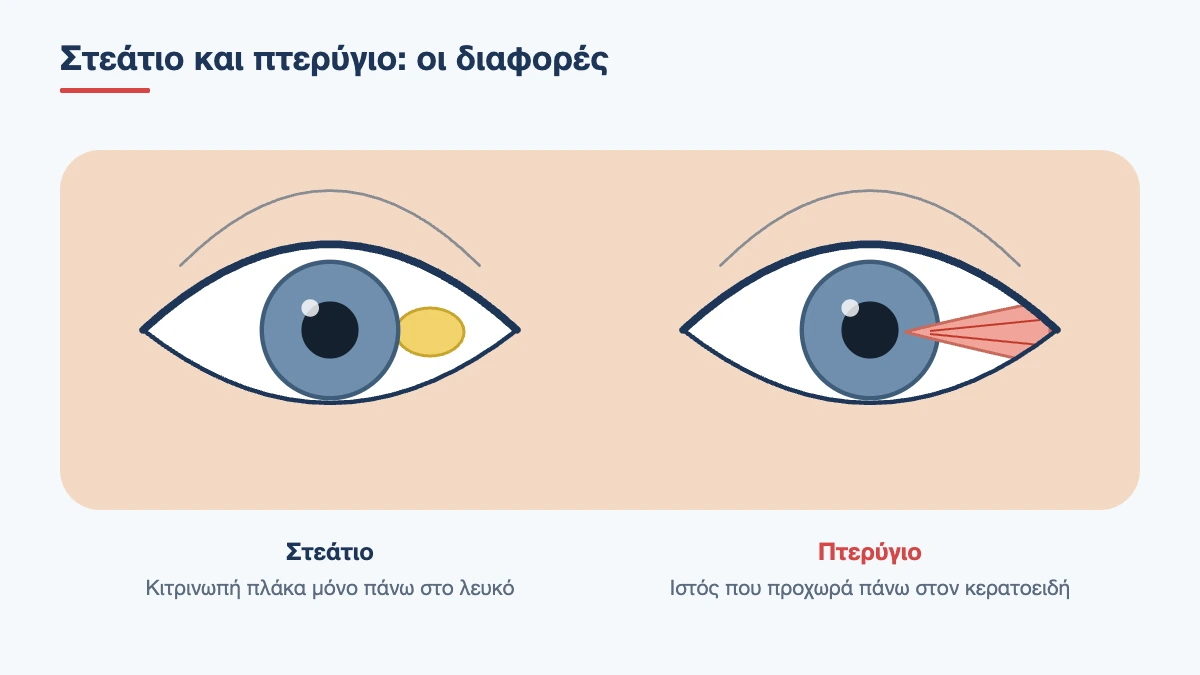
The two conditions have the same cause and appear in the same place, which is why they are often confused. Their behaviour, however, differs substantially.
| Pinguecula | Pterygium | |
|---|---|---|
| Appearance | Yellowish, round or triangular patch | Pink, fleshy, wing-shaped tissue with blood vessels |
| Location | Only on the white of the eye | Grows onto the cornea |
| Progression | Stable or very slow growth | Can grow towards the centre |
| Effect on vision | None | Astigmatism and, if it reaches the pupil, reduced vision |
| Surgery | Rarely needed | Often, when it grows or causes discomfort |
In some people with continued sun exposure, a pinguecula can develop into a pterygium. The sign we look for is whether the tissue has started to cross the edge and grow onto the cornea. That is why, at every check-up, the pinguecula is photographed or measured so that it can be compared.
What else can it look like?
The diagnosis is usually obvious, but there are conjunctival lesions that look like a pinguecula at first and need different management:
- Conjunctival cyst: a clear, fluid-filled blister, not a yellowish patch
- Conjunctival naevus: a brown or pale spot, often present since childhood, with small cysts inside it
- Nodular episcleritis: a red, tender nodule that appears suddenly and hurts when pressed
- Phlycten: a small whitish nodule at the edge of the cornea, caused by hypersensitivity to bacteria on the eyelids
- Ocular surface neoplasia: rare, but this is the one that must not be missed. It has a gelatinous or white, rough appearance, its own feeder blood vessels, irregular edges, and grows over months
Signs that make a “pinguecula” suspicious and call for an examination without delay are rapid growth, a change in colour or shape, bleeding, appearance in an unusual position, for example above or below rather than at the sides, and extension onto the cornea. In these cases the lesion is removed and sent for histological examination.
A yellow spot or a yellow eye?
One clarification is needed for anyone searching for “yellow in the eye”. A pinguecula is a localised yellowish bump in a specific spot. If, on the other hand, the whole white of both eyes has turned evenly yellow, this is jaundice, which is caused by a liver or bile duct problem and needs an urgent medical assessment, not an eye examination.
Diagnosis
Diagnosis is made by examination at the slit lamp and requires no special tests. The ophthalmologist checks the position, size, colour and blood vessels of the lesion, whether it has crossed onto the cornea and the condition of the eye surface around it. A dye is used to check tear quality and whether there are areas that dry out. The eyelids are also assessed, because blepharitis often coexists and keeps the irritation going. A photograph of the front of the eye records its appearance for future comparison.
Treatment
A pinguecula does not disappear on its own and there are no drops that dissolve it. This is not a problem, because most of the time it does not need to go. Treatment is aimed at the symptoms, not at the bump itself.
When it causes no discomfort
No treatment. Protection from the sun, so that it does not grow, and a check at your annual eye examination.
When it causes dryness and a foreign body sensation
Artificial tears, preferably preservative-free, three to six times a day depending on the discomfort, and a thicker gel at night if the eye is irritated in the morning. Lubrication smooths the surface over the pinguecula and reduces friction with the eyelid. Dry eye and blepharitis are treated at the same time, if present.
When it becomes inflamed
For pingueculitis, a short course of anti-inflammatory drops, either a mild steroid or a non-steroidal anti-inflammatory, is given for one to two weeks, together with frequent lubrication and cold compresses. Steroids are effective, but they are used only on prescription and for a limited time, because prolonged use can raise eye pressure or cause cataract.
Over-the-counter eye drops that “whiten” the eye are not recommended. They constrict the blood vessels temporarily, but with frequent use the eye becomes redder once their effect wears off, creating a vicious circle.
When is surgical removal needed?
Removal is rarely necessary. We discuss it when:
- inflammation is frequent and not controlled with drops
- the pinguecula is so raised that tears do not cover the cornea next to it, and a dry, thin area develops there
- it prevents the use of contact lenses that the patient needs
- its appearance greatly bothers the patient
- there is doubt about its nature and histological examination is needed
The procedure is performed under local anaesthesia, with drops and a small injection, and takes about 20 minutes. The abnormal tissue is removed and the gap is covered with a small graft of healthy conjunctiva from the upper part of the same eye, held in place with biological glue or fine stitches. Covering with a graft reduces the chance of recurrence and gives a better cosmetic result. After surgery the eye is red for 2 to 4 weeks and drops are needed for about a month. The risks are small: recurrence, a visible scar, prolonged redness. However, because an operated eye may look worse than before for a while, removal for purely cosmetic reasons is decided carefully and with realistic expectations.
In selected cases, laser photocoagulation has also been used, which shrinks the lesion without an incision. It is not suitable for every pinguecula and does not provide tissue for examination.
Book an appointment with the doctor
An examination and clear advice on your case at our practice in Neo Psychiko.
Prevention: how to stop it growing
Prevention is the real treatment, because the same measure that prevents a pinguecula also prevents it from developing into a pterygium, as well as preventing flare-ups.
- Sunglasses with full UV400 protection whenever you are outdoors, not only in summer. Cloud cover lets a large proportion of ultraviolet radiation through. See what to look for when buying in the article on sunglasses
- A wraparound frame, to block light coming in at an angle
- A hat with a brim, which halves the radiation reaching the eyes
- Extra care at the sea, in snow and on sand, where reflection multiplies exposure
- Protective glasses for work involving dust, sawdust, smoke or welding
- Artificial tears before and after exposure to wind, air conditioning or long hours at a screen
- Stopping smoking, which irritates the surface of the eye
- Sunglasses for children too. The damage is cumulative and a large part of exposure happens in childhood and youth
Pinguecula in young people
Although it is considered a change of later life, pinguecula is increasingly seen in people aged 25 to 40, mainly in those who grew up by the sea, do water sports or work outdoors. At these ages it matters more, for two reasons. The first is that there are many decades of exposure ahead, and therefore a greater chance of it growing or developing into a pterygium. The second is that younger people more often wear contact lenses and spend many hours on screens, two conditions that dry out the surface of the eye and make a pinguecula more bothersome. Adopting proper sunglasses early is the most effective intervention here.
What helps at home and what does not
During a flare-up, cold compresses for a few minutes, two to three times a day, relieve the burning. Artificial tears kept in the fridge are even more soothing. It also helps to avoid, for a few days, air conditioning blowing on your face, smoke and swimming in chlorinated pools. On the other hand, chamomile, tea and other herbal infusions have no place in the eye: they are not sterile, can cause allergy and have no effect on the pinguecula. The same applies to rubbing or “massaging” the bump, which only irritates it further.
Monitoring: how often do you need a check-up?
A pinguecula that causes no discomfort only needs to be checked once a year, as part of a routine eye examination. If it flares up often, is very close to the cornea or has changed since the previous photograph, the next check is at 6 months. Between visits, the simplest way to keep an eye on it is a close-up photo on your phone every few months, in the same light and looking towards the opposite side.
Pinguecula and contact lenses
Most people with a pinguecula wear contact lenses without any problem. If the bump is quite raised, the edge of a soft lens may rest on it and irritate it. The solution is often simple: a lens with a different diameter or curvature, a material that retains more moisture, fewer hours of wear and lubricating drops that are compatible with lenses. On days when the pinguecula is inflamed, the lenses stay in their case.
Pinguecula and eye surgery
A pinguecula is not an obstacle to cataract surgery or to correcting myopia with laser eye surgery. Before refractive surgery, we simply check that the surface of the eye is calm and well lubricated, because dryness after laser can temporarily make a pinguecula more bothersome.
When to get examined
Book an appointment if you have noticed a bump on the white of your eye for the first time and want to know what it is, if your pinguecula often turns red, if it is growing, changing colour or approaching the coloured part of the eye, or if it is getting in the way of your contact lenses. A slit lamp examination clarifies the diagnosis in a few minutes. Clinic in Neo Psychiko, Athens, telephone 210 677 0007 or use the contact form.
A bump on the white of your eye?
A slit lamp examination shows whether it is a pinguecula or a pterygium. Book an appointment.
Frequently Asked Questions about Pinguecula
Is a pinguecula dangerous?
No. It is a benign, sun-related change in the conjunctiva; it is not a tumour and does not turn into cancer. It does not affect your vision. You need an examination if it grows quickly, changes appearance, bleeds or extends onto the coloured part of the eye.
Does a pinguecula go away on its own or with eye drops?
It does not disappear on its own and no eye drop dissolves it. Lubricating and anti-inflammatory drops reduce the redness and discomfort, not the bump itself. The only way to remove it is a minor surgical procedure, which is rarely needed.
What is the difference between a pinguecula and a pterygium?
A pinguecula is a yellowish patch that stays on the white of the eye. A pterygium is pink, fleshy tissue with blood vessels that grows onto the cornea and can affect vision. They share the same cause, and in some people a pinguecula can develop into a pterygium.
Does a pinguecula grow over time?
It usually stays the same or grows very slowly over years. Continued unprotected sun exposure encourages it to grow. Sunglasses with a UV400 filter and a hat are the best way to keep it as it is.
Why does it become red from time to time?
Because it becomes inflamed, usually after exposure to sun, wind, dust or smoke, or when the eyes are dry. This is called pingueculitis; it lasts a few days and is treated with lubricating drops and, if needed, a short course of anti-inflammatory drops.
Is it worth removing for cosmetic reasons?
It can be done, but it needs careful thought. After surgery the eye stays red for several weeks and there is a small chance of scarring or recurrence. Removal is mainly recommended when there is frequent inflammation or a problem with contact lenses.
Can I wear contact lenses if I have a pinguecula?
Yes, in most cases. If the lens rubs on the bump, changing the lens type or diameter and using lubricating drops helps. When the pinguecula is inflamed, lens wear is stopped until the eye settles.
Medically reviewed by: Dr. Vasileios Skouteris MD, FEBO