
Written by Vasileios Skouteris MD, FEBO, Ophthalmic Surgeon
Page contents
- Why does eyelid position matter?
- Entropion: when the eyelid turns inwards
- Ectropion: when the eyelid turns outwards
- The differences at a glance
- When you need to be seen urgently
- Diagnosis
- Temporary measures until surgery
- Surgical correction
- Recovery and results
- What happens if it is left untreated?
- When to book an appointment
- Frequently Asked Questions about Entropion and Ectropion
Entropion and ectropion are two opposite disorders of eyelid position. In entropion the eyelid margin turns inwards and the lashes rub against the eye. In ectropion it turns outwards, moves away from the eye and leaves its inner surface exposed. They usually affect the lower eyelid, occur mainly after the age of 60 because of tissue laxity, and cause redness, watering and irritation that eye drops do not resolve. The definitive treatment for both is a minor operation under local anaesthetic.
Why does eyelid position matter?
The eyelid is not simply a cover. It is a precision mechanism that must sit exactly against the surface of the eye to do three jobs. It protects the cornea from injury and drying out. It spreads the tears evenly with every blink, like a windscreen wiper. And it drains them, since the punctum, the small opening in the corner towards the nose, has to dip into the pool of tears in order to “draw them in”.
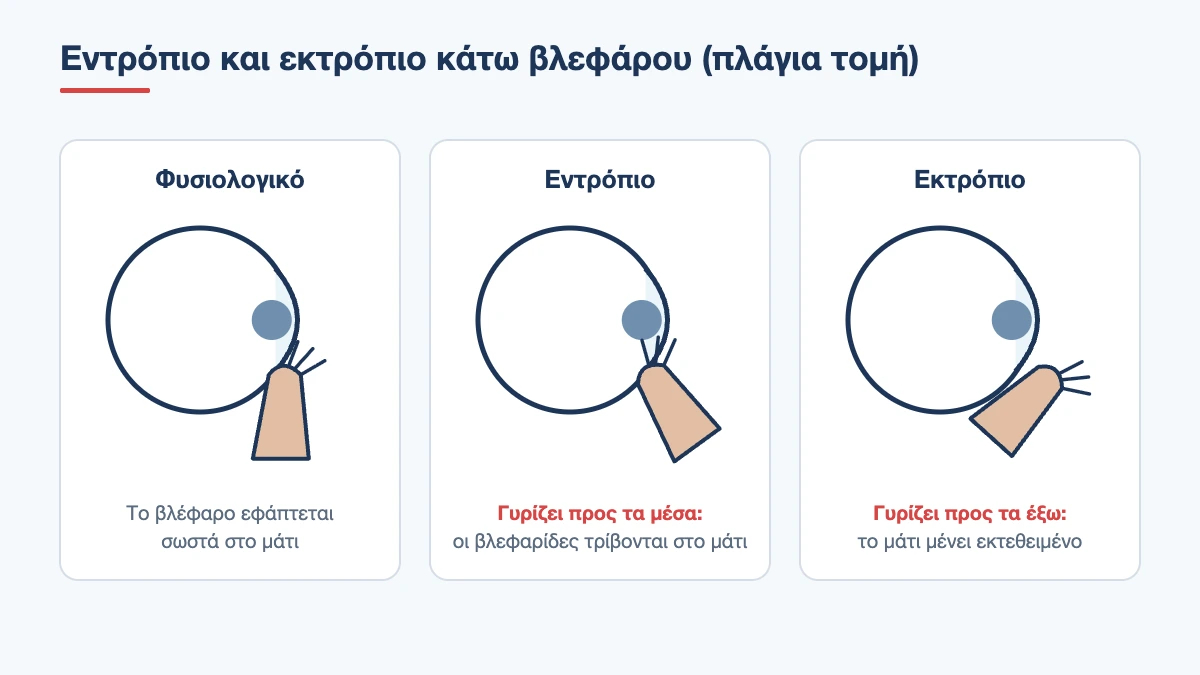
The eyelid keeps its shape thanks to a firm fibrous framework, the tarsal plate, which is anchored by two tendons to the bones of the orbit, one towards the nose and one towards the temple, like a hammock tied between two trees. Underneath, a thin layer of muscle and fibrous tissue, known as the lower eyelid retractors, stabilises it vertically. All around it, the orbicularis muscle closes it. When the tendons stretch, when the retractors become detached or when a scar pulls the eyelid in one direction, the balance is lost and the margin turns inwards or outwards.
Interestingly, the same cause, age-related laxity, can lead to either entropion or ectropion. Which of the two develops depends on subtle anatomical differences: how deeply the eye sits in the orbit, how strong the orbicularis muscle is and whether the retractors are still holding.
Entropion: when the eyelid turns inwards
Types and causes
- Involutional (age-related) entropion: the most common form. The lower eyelid has become horizontally lax, the retractors no longer hold it and the orbicularis muscle “rides up” over the margin and folds it towards the eye. At first it comes and goes, mainly when you squeeze your eyes shut, and over time it becomes permanent
- Spastic entropion: caused by a strong spasm of the orbicularis muscle in an eye that is already irritated, for example after surgery, inflammation or injury. A vicious circle often develops: irritation causes spasm, the spasm turns the eyelid in, and the lashes cause more irritation
- Cicatricial entropion: the inner surface of the eyelid has shrunk because of scarring and pulls the margin inwards. Causes include chemical burns, chronic infections such as trachoma, autoimmune diseases of the conjunctiva, severe drug reactions and long-term use of certain eye drops. It can also affect the upper eyelid
- Congenital entropion: rare. More often, babies have a fold of skin that pushes the lashes towards the eye, and this usually corrects itself as the face grows
Symptoms
- a strong foreign body sensation, as if there is sand or a hair in the eye
- redness and stinging
- constant watering
- discomfort in light and wind
- mucous discharge
- frequent blinking or squeezing of the eyelids, which makes the problem worse
- pain and blurred vision once the cornea has been damaged
Entropion is the more dangerous of the two conditions. The lashes and skin rub against the cornea thousands of times a day and can cause abrasions, an ulcer, infection and permanent scarring. In older people with reduced sensation in the eye, the damage progresses without severe pain. That is why entropion is not something we leave to “see how it goes”.
Entropion or trichiasis?
In trichiasis the eyelid is in the correct position, but a few lashes grow in the wrong direction and touch the eye. The symptoms are the same, but the treatment differs: the few misdirected lashes are removed, or their follicles are destroyed with electrolysis or laser, without the need to correct the eyelid. A common cause of trichiasis is chronic blepharitis.
Book an appointment with the doctor
An examination and clear advice on your case at our practice in Neo Psychiko.
Ectropion: when the eyelid turns outwards
Types and causes
- Involutional (age-related) ectropion: the most common form. The tendons supporting the lower eyelid have stretched, so the eyelid sags and tilts outwards, at first only near the nose and later along its whole length. It is made worse by constantly wiping tears downwards
- Paralytic ectropion: occurs with facial nerve palsy, for example Bell’s palsy, after a stroke or after surgery on the ear and parotid gland. The orbicularis muscle has no tone, the lower eyelid drops and the eye does not close
- Cicatricial ectropion: the skin of the lower eyelid has shortened and pulls the margin downwards. It is caused by chronic sun damage, burns, injuries, chronic dermatitis, removal of skin tumours or excessive skin removal during previous lower eyelid blepharoplasty
- Mechanical ectropion: a tumour, a cyst or marked swelling weighs the eyelid down and pulls it
- Congenital ectropion: very rare, usually as part of other eyelid abnormalities
Symptoms
- constant watering that runs down the cheek, because the punctum no longer touches the eye
- the pink inner surface of the eyelid is visible, and over time it becomes red, thickened and dry
- irritation, burning and a feeling of dryness, despite the watering
- mucous discharge and crusting on the lashes
- irritated skin on the lower eyelid and cheek because of the moisture
- incomplete closure of the eye, especially during sleep
- cosmetic concern, with the eye looking “droopy” and red
The paradox of ectropion is that the eye waters and dries out at the same time. Tears are produced, but they are not spread properly and do not drain, so they overflow, while the cornea remains exposed. In severe cases, especially paralytic ectropion, exposure can lead to keratitis and an ulcer.
The differences at a glance
| Entropion | Ectropion | |
|---|---|---|
| Direction | Inwards, towards the eye | Outwards, away from the eye |
| What you see | The lashes are not visible, they are turned in | The red inner surface is visible |
| Main complaint | Scratching, pain | Watering, irritation |
| Risk to the cornea | High, from rubbing | Moderate, from exposure |
| How urgent | Weeks | Weeks to a few months |
When you need to be seen urgently
Whether it is entropion or ectropion, ask to be examined the same day or the next day if:
- the eye is very painful or the pain wakes you at night
- your vision has become blurred
- light bothers you a lot
- you see a white or grey spot on the coloured part of the eye
- there is a pus-like discharge
- the eyelid turned suddenly, together with a drooping corner of the mouth or inability to close the eye, which point to facial nerve palsy
Diagnosis
The diagnosis is made with a clinical examination and a few simple tests that show which part of the mechanism has failed, and therefore what needs to be corrected:
- Snap-back test: we pull the lower eyelid down and let it go. A healthy eyelid returns to its position immediately. A lax one returns slowly, or only after you blink
- Distraction test: we measure how many millimetres the eyelid moves away from the eye when pulled forwards. More than 8 millimetres indicates significant laxity
- Assessment of the tendons at both corners, to see which one has stretched
- Provocation: we ask you to squeeze your eyes tightly shut and then open them. An entropion that only appears intermittently is revealed this way
- Examination of the inner surface of the eyelid for scarring, and of the skin for shortening
- Examination of the cornea at the slit lamp with dye, for abrasions or dry areas
- Assessment of tear drainage and of the position of the punctum
- Assessment of facial nerve function and of whether the eye closes fully
When there is scarring of the conjunctiva without an obvious cause, a biopsy may be needed to rule out an autoimmune disease, because in that case the disease must be brought under control first and surgery carried out afterwards. If the ectropion is caused by a lump, the lump is removed and sent for histological examination.
Temporary measures until surgery
The following do not correct the eyelid, but they protect the eye and give relief until the definitive correction, or for people who cannot have surgery.
For both
- preservative-free artificial tears, frequently during the day
- lubricating ointment or gel at night
- avoiding rubbing
For entropion
- Tape: a strip of hypoallergenic tape is stuck from the lower eyelid, just below the lashes, towards the cheek, with a slight pull downwards and outwards, so that it holds the margin turned the right way. It is changed daily
- A bandage contact lens, which protects the cornea from the lashes
- Botulinum toxin injection into the orbicularis muscle of the lower eyelid. It relaxes the muscle that folds the margin in and lasts about 3 months. It is useful in spastic entropion and for patients waiting for surgery
- Everting sutures: two to three absorbable stitches placed in the clinic under local anaesthetic, in a few minutes, which turn the eyelid outwards. The result lasts from months to years, and it is a good option for very elderly or frail patients
For ectropion
- wipe tears with an upward movement towards the nose, never downwards
- tape the eye closed while sleeping if it does not seal
- protect the eyelid skin with a bland ointment
- wear wraparound glasses in windy weather
- in facial nerve palsy, which often improves within weeks or months, protecting the cornea with lubrication and closing the eye at night is the main treatment while we wait for recovery
Book an appointment with the doctor
An examination and clear advice on your case at our practice in Neo Psychiko.
Surgical correction
The operation is done under local anaesthetic, with or without light sedation, takes 30 to 45 minutes per eyelid, and the patient goes home the same day. The technique is chosen according to what has failed.
Eyelid tightening
This is the basis of most operations, both for age-related entropion and for ectropion. Through a small incision at the outer corner of the eye, the eyelid is shortened by a few millimetres and the end of the tarsal plate is re-anchored with a stitch to the periosteum of the orbit. The eyelid is tightened and regains contact with the eye, just as we tighten the ropes of a hammock that has started to sag.
Reattachment of the retractors
In entropion, tightening is usually combined with reattaching the retractors to the lower border of the tarsal plate, through an incision just below the lashes. This restores vertical stability, and the orbicularis muscle can no longer fold the margin in.
Correction of the inner part
When ectropion mainly affects the part near the nose and the punctum has turned outwards, a small diamond-shaped piece is removed from the inner surface of the eyelid, just below the punctum, so that as it heals it turns back towards the eye.
Cicatricial forms
In cicatricial ectropion tightening is not enough, because skin is missing. The scar is released and the defect is covered with a skin graft, usually from the upper eyelid or from behind the ear, or by moving neighbouring skin. In cicatricial entropion the problem is on the inner surface, which is lengthened with special incisions in the tarsal plate or with a mucous membrane graft.
Paralytic ectropion
If the palsy does not recover, the lower eyelid is supported with tightening or a sling, and a small weight can be placed in the upper eyelid to help it close with gravity. In severe exposure, the outer ends of the two eyelids are stitched together to make the opening smaller.
Recovery and results
- cold compresses for the first 48 hours and sleeping with your head raised
- antibiotic ointment on the stitches and eye drops for 1 to 2 weeks
- bruising and swelling for 1 to 2 weeks
- removal of stitches after 7 to 14 days, if they are not absorbable
- avoiding strenuous exercise, swimming and rubbing for 2 to 3 weeks
- tenderness and a feeling of tightness at the outer corner for a few weeks
Relief in entropion is immediate: from the first day the lashes no longer touch the eye. In ectropion the watering and redness settle gradually over a few weeks, as the previously exposed conjunctiva recovers. Success rates for the age-related forms exceed 90%. Cicatricial and paralytic forms are more demanding and sometimes need an additional operation.
Possible complications include slight under-correction or over-correction, asymmetry with the other eye, infection or a reaction to the stitches, and recurrence over the years, because the tissues continue to loosen. If the problem returns, the correction can be repeated.
What happens if it is left untreated?
In entropion, chronic rubbing leads to repeated abrasions, new blood vessels and scarring of the cornea, with permanent loss of vision, and the risk of a bacterial ulcer is real. In ectropion, the exposed conjunctiva thickens and hardens, which makes the eyelid even heavier and the correction more difficult, while constant watering and infections take their toll on daily life.
There is also a practical reason not to delay correction: before any intraocular operation, such as cataract surgery, the eyelids must be in the right position and the surface of the eye must be healthy, because an eyelid that rubs or does not protect the eye increases the risk of infection and delays healing.
When to book an appointment
If your lower eyelid turns inwards or outwards, if your eye is constantly red and watering and drops do not help, or if you constantly feel something scratching, an examination shows whether eyelid position is to blame and what condition the cornea is in. Temporary measures for immediate relief can be applied at the same visit. The clinic is in Neo Psychiko, Athens: call 210 677 0007 or use the contact form.
Does your eyelid turn inwards or outwards?
We check the position of the eyelid and the cornea, with measures for immediate relief. Book an appointment.
Frequently Asked Questions about Entropion and Ectropion
What is the difference between entropion and ectropion?
In entropion the eyelid margin turns inwards and the lashes rub against the eye. In ectropion it turns outwards, away from the eye, and its red inner surface becomes visible. Both are usually caused by tissue laxity with age.
Can they be corrected without surgery?
Not permanently. Lubricants, tape, botulinum toxin and everting sutures protect the eye and give temporary relief, but the position of the eyelid is only restored for good with surgery that tightens and repositions it.
Is entropion dangerous for sight?
It can be. The constant rubbing of the lashes damages the cornea and can cause an ulcer, infection and permanent scarring. If there is pain, blurred vision or a white spot on the eye, you need to be examined the same day.
How long does the operation take, and is a hospital stay needed?
It takes 30 to 45 minutes per eyelid, is done under local anaesthetic and does not require a hospital stay. Bruising and swelling settle in 1 to 2 weeks, and most people return to their usual activities within a few days.
Can it come back after surgery?
The success rate for age-related forms is over 90%. However, because the tissues continue to loosen over the years, the problem returns after some time in a small proportion of patients. In that case the correction can be repeated.
Why does my eye water when the eyelid is turned outwards?
Because the punctum, the opening through which tears drain, has moved away from the eye and cannot collect them. At the same time the exposed eye becomes irritated and produces more tears. The result is watering together with a feeling of dryness.
What are everting sutures for entropion?
They are two to three absorbable stitches placed in the clinic under local anaesthetic, which turn the eyelid outwards. The result lasts from months to years. They are preferred for very elderly patients or those who cannot undergo a more extensive operation.
Medically reviewed by: Dr. Vasileios Skouteris MD, FEBO