Page contents
- What changes in the eyes during pregnancy?
- Why laser eye surgery is not done during pregnancy
- What about breastfeeding?
- When can I have laser eye surgery after giving birth?
- I am planning a pregnancy. Should I have laser surgery before or after?
- I had laser eye surgery and then became pregnant. Is there a risk?
- Short-sightedness and vaginal delivery
- Looking after your vision during pregnancy
- Eye symptoms that are not normal in pregnancy
- How to prepare for laser eye surgery after breastfeeding
- Book an appointment
- Frequently Asked Questions
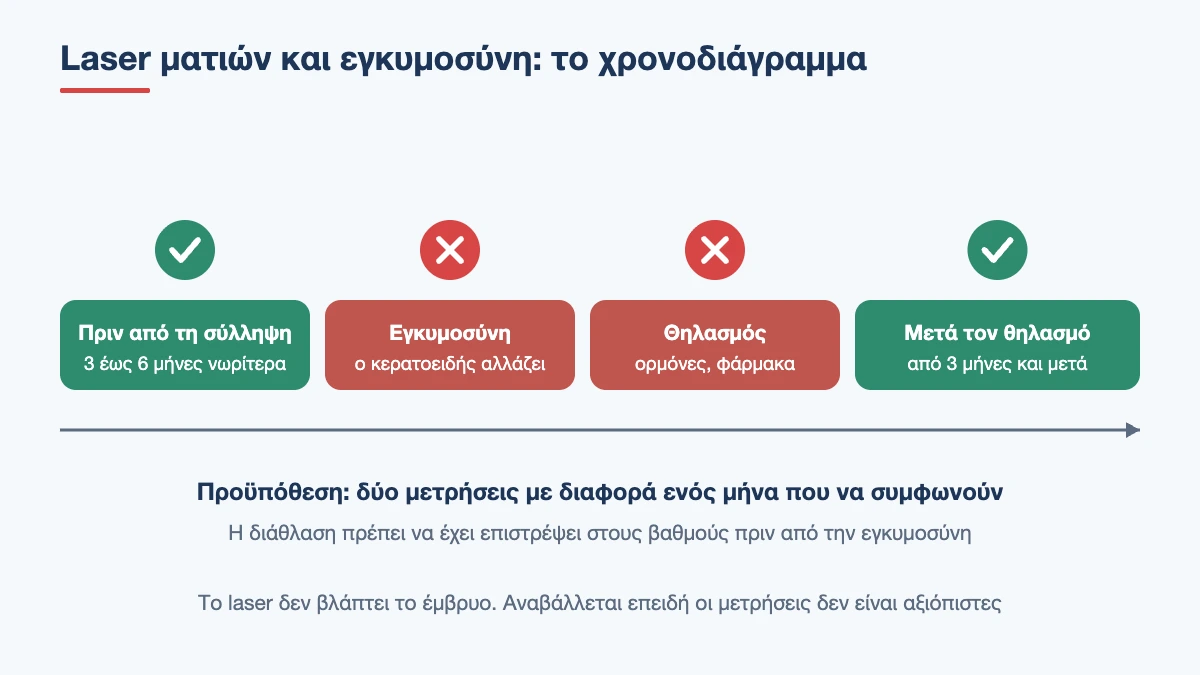
Laser eye surgery to correct short-sightedness (myopia), long-sightedness (hyperopia) or astigmatism is not performed during pregnancy or while breastfeeding. The reason is not that the laser harms the baby, since its energy does not reach beyond the surface of the eye. It is that hormones temporarily change the shape and thickness of the cornea, so the measurements are not reliable, and that the medicines needed after the procedure are best avoided. The procedure can be safely scheduled at least 3 months after you stop breastfeeding.
What changes in the eyes during pregnancy?
The hormonal changes of pregnancy, mainly the rise in oestrogen and progesterone and fluid retention, affect every tissue in the body, and the eye is no exception.
- The cornea thickens and changes curvature. It holds more water and becomes slightly thicker and steeper, mostly in the second and third trimesters
- Your prescription shifts. Many women notice that their distance vision is a little more blurred, usually by a quarter of a dioptre to one dioptre. The change is temporary
- Corneal sensitivity decreases
- The eyes become dry. The composition of the tears changes and dry eye is common
- Contact lenses become uncomfortable. Because of the change in corneal shape and the dryness, lenses that were comfortable for years can suddenly become intolerable
- Intraocular pressure falls slightly
All these changes settle within a few weeks to months after giving birth or stopping breastfeeding. This is why we do not recommend new glasses for a small difference in the third trimester, unless it makes driving or work difficult.
Why laser eye surgery is not done during pregnancy
1. The measurements are not reliable
Refractive surgery is precision surgery. The laser removes tissue with an accuracy of thousandths of a millimetre, based on the refraction, topography and corneal thickness measured beforehand. If these measurements are taken on a cornea that is temporarily swollen and has an altered curvature, the correction will be calculated for an eye that will no longer exist in a few months. The likely result is overcorrection or undercorrection and the need for a second procedure.
2. Healing is less predictable
Hormones affect the way the cornea heals. With surface techniques such as PRK, there is a higher chance of haze and regression of the correction. In addition, pregnancy appears to affect the biomechanical strength of the cornea, which matters in eyes with a thin cornea or a predisposition to keratoconus.
3. The medicines
After the procedure, antibiotic and steroid drops are used for weeks, and for months after PRK. A small amount of every eye drop is absorbed into the bloodstream. The risk is probably very small, but for a procedure that is not essential and can wait, there is no reason to take it. The same applies to the sedative given before the procedure and to certain substances used during surface techniques.
4. Dry eye
Laser surgery causes temporary dryness for a few months. Added to the dryness of pregnancy, it makes recovery harder and the quality of vision worse.
What about breastfeeding?
The same restrictions apply. While you are breastfeeding, hormone levels remain different, the cornea has not fully returned to normal and the refraction may not be stable. Small amounts of the medicines also pass into breast milk. This is why the procedure is postponed until breastfeeding has finished.
When can I have laser eye surgery after giving birth?
The general rule is at least 3 months after you stop breastfeeding, or 3 months after the birth if you do not breastfeed. In practice we look for three things:
- breastfeeding has stopped completely and your periods have returned
- two refraction measurements, at least one month apart, that agree with each other and with your prescription before pregnancy
- stable corneal topography and good tear quality
In some women stabilisation takes a little longer, up to 6 months. There is no need to rush. Waiting one or two months is a small price to pay for a correction that will last for decades.
I am planning a pregnancy. Should I have laser surgery before or after?
Both options are fine. What matters is allowing safe intervals.
Before pregnancy
If you have the procedure first, allow at least 3 months before conception with LASIK techniques, and up to 6 months with PRK, where steroid drops are continued for longer. This way, healing and treatment will be complete. The advantage is practical: you go through pregnancy and the first months with your baby without glasses and without contact lenses, which are often uncomfortable during that period.
After pregnancy
If you are already trying to conceive or do not want to delay, it is better to wait and have the procedure once breastfeeding is over. The same applies if you are planning a second pregnancy soon: there is a window in between, provided the intervals are respected.
IVF and hormone treatments
Ovarian stimulation medicines raise oestrogen to very high levels and can affect the refraction in the same way as pregnancy. Laser surgery is postponed during an IVF cycle. The contraceptive pill, on the other hand, is not a contraindication. It may slightly worsen dry eye, which is assessed during the pre-operative examination.
I had laser eye surgery and then became pregnant. Is there a risk?
This is one of the most common and most worrying questions, and the answer is reassuring.
- For the baby: the laser acts only on the cornea and has no effect on the foetus. If you are still using drops, let your ophthalmologist and your obstetrician know. The regimen is usually adjusted or completed earlier, and absorption is reduced if you press gently on the inner corner of the eye for one minute after each drop
- For your eyes: you may notice a small, temporary return of your prescription or more dryness. In most women vision returns to normal after the birth. If the procedure was done years earlier, pregnancy does not undo the result
- For the delivery: laser eye surgery does not affect how you give birth. The cornea is not at risk from pushing during labour
Short-sightedness and vaginal delivery
There is a widespread belief that women with high myopia should have a caesarean section to avoid retinal detachment. The available evidence does not support this: pushing during labour has not been shown to cause detachment, either in high myopia or in women who have had previous retinal treatment. What does make sense is a dilated fundus examination during pregnancy for women with high myopia or a history of retinal tears, so that anything found can be treated with retinal laser, which is safe in pregnancy too. The final decision on the mode of delivery belongs to the obstetrician and rarely needs to be determined by the eyes.
It is also worth remembering that laser surgery for short-sightedness corrects the prescription, not the myopic eye. The retina stays the same and needs the same monitoring.
Looking after your vision during pregnancy
- Keep a pair of glasses with an up-to-date prescription. You will need them during the months when contact lenses are uncomfortable
- Fewer hours in contact lenses, and daily disposable lenses if monthly lenses dry out
- Preservative-free artificial tears. They are safe during pregnancy and breastfeeding
- Breaks from screens and good hydration
- Do not change your glasses for a small difference at the end of pregnancy. Wait for your vision to stabilise after the birth
- An eye examination is safe. Dilating drops are used when needed, and all diagnostic tests, such as OCT and topography, are painless and involve no radiation
Eye symptoms that are not normal in pregnancy
Mild blurring and dryness are expected. The following are not, and need prompt contact with your doctor:
- sudden blurring, double vision or loss of part of the visual field
- flashes, sparkles or dark spots, especially together with headache, swelling or high blood pressure. These can be signs of pre-eclampsia
- a blurred spot or distortion in the centre of vision in one eye, which may be due to fluid collecting under the macula, a condition that occurs more often in the third trimester and usually resolves after the birth. See the page on central serous chorioretinopathy
- pain or a very red eye
Women who had diabetes before pregnancy need a retinal examination at the start of pregnancy and in every trimester, because diabetic retinopathy can worsen quickly. Diabetes that appears only during pregnancy (gestational diabetes) does not carry this risk.
How to prepare for laser eye surgery after breastfeeding
Once breastfeeding is over, you can book the pre-operative assessment. It includes refraction with and without drops, corneal topography and pachymetry, a tear assessment, pupil measurement and a retinal examination. If you wear contact lenses, stop at least one week beforehand for soft lenses and longer for rigid lenses, so that the cornea returns to its natural shape. Bring your old glasses prescriptions with you: comparing them with your prescription before pregnancy shows whether your vision has truly stabilised. For the available techniques, see the page on laser eye surgery and the article LASIK, PRK or TransPRK.
Book an appointment
If you are planning a pregnancy and considering laser eye surgery, or if you have given birth and want to know when the right time is, one visit is enough to plan the timeline. The practice is in Neo Psychiko, Athens: call 210 677 0007 or use the contact form.
Frequently Asked Questions
Can I have laser eye surgery for short-sightedness if I am pregnant?
No. During pregnancy hormones temporarily change the shape and thickness of the cornea, so the measurements are not reliable and the result may not be accurate. The medicines needed after the procedure are also avoided.
How long after breastfeeding can I have laser eye surgery?
Usually 3 months after breastfeeding has stopped completely, provided two measurements one month apart show that your prescription is stable. In some women stabilisation takes up to 6 months.
I had laser eye surgery and then found out I was pregnant. Is the baby at risk?
No. The laser acts only on the surface of the eye. Tell your ophthalmologist and your obstetrician about the drops you are using, so that the treatment can be adjusted if needed.
How long before a pregnancy should the procedure be done?
At least 3 months before conception for LASIK techniques and up to 6 months for PRK, so that healing and the course of drops are complete.
Does pregnancy ruin the result of previous laser eye surgery?
Usually not. Mild, temporary blurring or dryness may appear during pregnancy and settles after the birth. In a few cases a small difference remains, which can be corrected later if it is bothersome.
I have high myopia. Do I need a caesarean section?
Myopia on its own is not an indication for a caesarean section. Vaginal delivery has not been shown to cause retinal detachment. A retinal examination during pregnancy is recommended and, if a tear is found, it is treated with laser before the birth.
Why can I not tolerate contact lenses during pregnancy?
Because the cornea changes shape slightly and the eyes become dry due to hormones. Fewer hours of wear, daily lenses, artificial tears and glasses all help. The problem settles after the birth.
Questions about your case?
Dr. Skouteris will examine you at his practice in Neo Psychiko and explain your options.

Ophthalmic surgeon trained at the John Radcliffe University Hospital in Oxford and Fellow of the European Board of Ophthalmology (FEBO).
Full profile