Page contents
- The Blepharoplasty Recovery Timeline
- When Can I Return to Each Activity?
- Aftercare at Home: What Speeds Up Recovery
- What Is Normal After Blepharoplasty
- Possible Complications of Blepharoplasty
- When to Call Your Doctor
- How to Reduce the Risk Before Surgery
- Book an Appointment
- Frequently Asked Questions about Blepharoplasty Recovery
Blepharoplasty recovery takes about two weeks for the bruising and swelling to settle, and two to three months for the final result to show. Most people return to office work within 7 to 10 days. Complications are rare, and most are mild and temporary, such as dryness and short-lived asymmetry. There is, however, one emergency complication that every patient should know about: bleeding behind the eye, which shows up in the first few hours as severe pain, hard swelling and a drop in vision.
In this guide you will find what to expect day by day, what is normal and what is not, and how to lower the risk of complications before you even have surgery. For how the operation itself is performed, see the page on laser blepharoplasty.
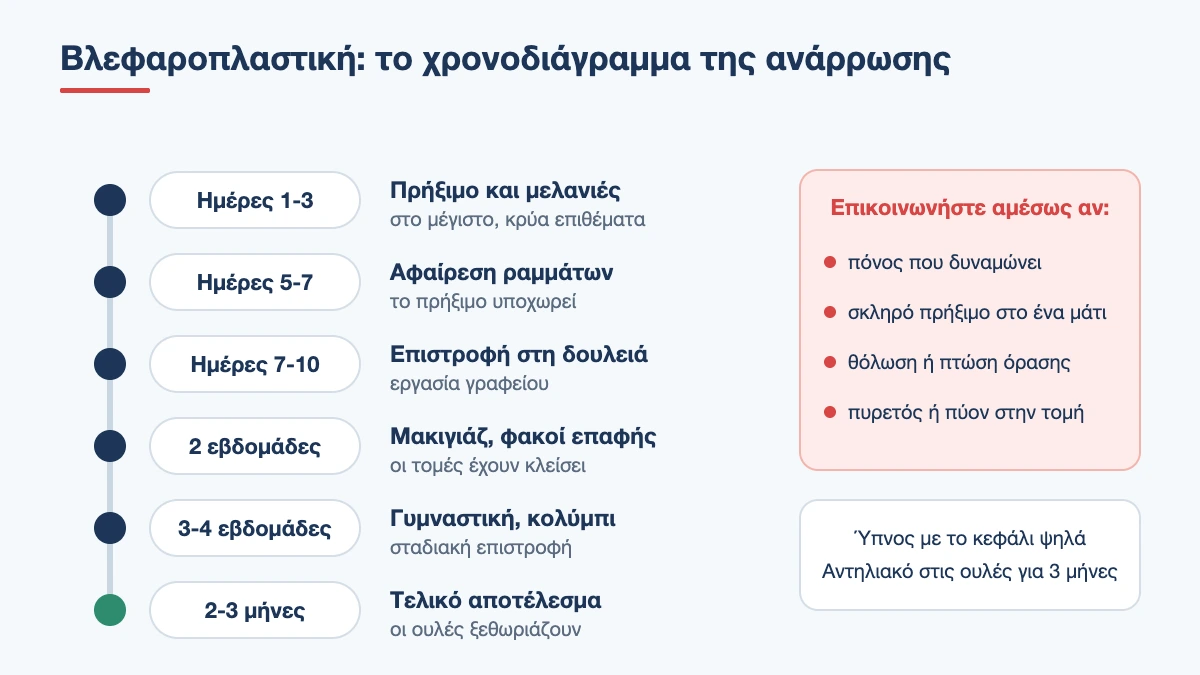
The Blepharoplasty Recovery Timeline
Day of surgery
You go home the same day, with someone to accompany you. The eyelids are numb from the local anaesthetic, your vision is blurred by the ointment and your eyes are watery. Pain is minimal, more a feeling of tightness and stinging, and it is controlled with paracetamol. The first few hours matter most for swelling: rest with your head raised and use cold compresses.
Days 1 to 3
Swelling and bruising peak on the second or third day and are often worse in the morning. It is normal to look worse than you did on the day of surgery. Bruising may track down onto the cheeks because of gravity. Your eyes may not close fully and may feel dry.
Days 4 to 7
The swelling starts to go down and the bruises change colour, from purple to greenish yellow. Stitches, if they are not dissolvable, are removed after 5 to 7 days, which takes a few minutes and is painless. You can read and look at screens for short periods.
Week 2
Most people feel comfortable going out and returning to work. Any remaining bruising can be covered with make-up, provided the incisions have closed and your doctor allows it.
Weeks 3 to 6
Some mild swelling remains, more noticeable in the morning and in the lower eyelids. The scars are pink and slightly firm. You gradually return to exercise.
Months 2 to 6
The swelling has gone completely, sensation in the skin returns, and the scars fade into fine, pale lines hidden in the upper eyelid crease or just below the lashes. The result can be judged definitively after three months.
When Can I Return to Each Activity?
| Activity | Approximately when |
|---|---|
| Showering from the neck down | The next day |
| Washing your hair with your head tilted back | After 2 to 3 days |
| Reading, television, screens | From day 2 or 3, with breaks |
| Driving | When your vision is clear and the swelling does not restrict your field of view, usually after 5 to 7 days |
| Office work | After 7 to 10 days |
| Eye make-up | After 10 to 14 days |
| Contact lenses | After 2 weeks |
| Walking | From the first few days |
| Gym, running, weights | After 3 to 4 weeks |
| Swimming, sauna | After 4 weeks |
| Flying | After the stitches are removed |
| Sun exposure without protection | Avoid for 3 months |
These times are a guide and will be adjusted by your surgeon, depending on whether the upper, the lower or all four eyelids were operated on.
Aftercare at Home: What Speeds Up Recovery
- Cold compresses for 10 to 15 minutes every hour while you are awake, for the first 48 hours. Use clean gauze soaked in iced water or an ice pack wrapped in a cloth, never ice directly on the skin
- Sleeping on your back with your head raised, on two or three pillows, for the first week
- Antibiotic ointment on the incisions and eye drops as prescribed
- Artificial tears frequently during the day and a lubricating gel at night, for dryness
- Gentle cleaning with saline, without rubbing
- Sunglasses outdoors, against sun, wind and dust
- High-factor sunscreen on the scars as soon as they have closed, for at least three months, so that they do not darken
- Little salt and plenty of water
What to avoid
- bending over, lifting heavy objects and straining for the first two weeks. These raise the pressure in the head and can cause bleeding
- rubbing or pulling the eyelids
- smoking, which slows healing and makes scars worse
- alcohol during the first week
- aspirin, anti-inflammatory painkillers and supplements that affect clotting, unless a doctor has recommended them for another reason
- hot baths, saunas and warm compresses in the first few days
- sleeping on your front or on your side
What Is Normal After Blepharoplasty
The following occur in most patients and settle without treatment:
- swelling and bruising, often uneven between the two eyes
- blurred vision from the ointment and tears
- watering or, on the contrary, dryness and a gritty feeling
- sensitivity to light
- a tight feeling and difficulty closing the eyes fully in the first few days
- numbness of the eyelid skin and lashes, for weeks to a few months
- itching at the incisions as they heal
- pink, slightly raised scars during the first month
- small white cysts along the scar, which are easily removed in the clinic
- slight asymmetry while there is swelling
- swelling of the conjunctiva (chemosis), which makes the white of the eye look like jelly. It is more common after lower eyelid surgery and settles within weeks with lubrication
Possible Complications of Blepharoplasty
More common and usually temporary
- Dry eye. This is the most common complaint. The eyelids blink less effectively for a few weeks. People who already had dry eyes before surgery feel it more
- Incomplete eye closure. Usually lasts days or a few weeks, due to swelling. If it persists, it means more skin was removed than should have been
- Prolonged swelling or bruising, especially in the lower eyelids
- A visible or thickened scar, more often at the ends of the incision. It improves with massage, silicone or an injection
Less common
- Haematoma under the skin, which may need to be drained
- Infection. This is rare in the eyelids because of their rich blood supply. It shows up as increasing redness, warmth, pain or pus after the third day
- Wound opening after rubbing or a knock
- Asymmetry that persists beyond three months
- Under-correction or over-correction. Skin or fat was left behind, or too much was removed and the eye looks “hollow”
- Drooping of the upper eyelid. Usually temporary, from swelling. In some people there was already ptosis (droopy eyelid) that had not been recognised and became apparent once the skin was removed
- Lower eyelid retraction or ectropion. The lower eyelid is pulled down or turns outwards, and white shows below the coloured part of the eye. This is the most significant complication of lower blepharoplasty and happens when the eyelid was already lax or too much skin was removed. Mild cases improve with massage; the rest need surgical correction of ectropion
- Double vision, rare and usually temporary, from swelling or injury to a small muscle near the lower eyelid fat
The emergency complication: bleeding behind the eye
It is very rare, in the order of one case in several thousand operations, but it is the only complication that threatens sight. Blood collects in the orbit, behind the eye, the pressure rises sharply and the blood supply to the optic nerve is cut off. It usually occurs within the first few hours up to the first 24 hours, often after coughing, vomiting, straining or a sudden rise in blood pressure. The signs are:
- sudden, severe and worsening pain in one eye
- hard, tense swelling, much greater than on the other side
- a bulging eye
- blurring or loss of vision, or double vision
- nausea
If this happens, do not wait until the morning. Contact your surgeon immediately or go to an on-call hospital. Prompt decompression, within one to two hours, saves sight.
When to Call Your Doctor
- pain that does not ease with paracetamol or gets worse
- swelling that increases quickly or is much greater on one side
- any drop in vision, beyond the blurring caused by the ointment
- bleeding from the incision that does not stop with gentle pressure for ten minutes
- redness, warmth or pus at the incisions, or a fever
- an eye that is very red and painful, with sensitivity to light
- an incision that has opened
How to Reduce the Risk Before Surgery
Most complications are prevented in the consulting room, before surgery, not during it.
The eye examination
The eyelids exist to protect the eye, and any change to them affects the surface of the eye. Before surgery, the following should have been checked:
- the quality and quantity of your tears. Pre-existing dry eye is treated first, and it affects how much skin will be removed
- how well your eyes close and whether the eyeball turns protectively upwards during sleep
- the position of the upper eyelid margin, for hidden ptosis that should be corrected at the same time
- the position of the eyebrows. If the brow has dropped, removing skin from the eyelid will pull it down further
- laxity of the lower eyelid. If it is lax, it needs tightening during the same operation, otherwise it risks being pulled downwards
- how prominent the eye is and the health of the cornea
- vision, eye pressure and medical history, especially previous laser vision correction, glaucoma or thyroid eye disease
What depends on you
- tell us about all your medicines and supplements. Blood thinners are only adjusted in agreement with the doctor who prescribed them
- get your blood pressure under control. Uncontrolled high blood pressure is the most important risk factor for bleeding
- stop smoking at least two weeks before and two weeks after surgery
- deal with any cough, constipation or allergy before the operation
- get your home ready in advance: pillows, ice packs, gauze, ready meals and someone to stay with you on the first night
- talk openly about the result you expect. Blepharoplasty gives a more rested look; it does not change the shape of your eyes or erase expression lines
Book an Appointment
If you are considering blepharoplasty, a full eye examination before surgery is the most important step towards a safe and natural result. If you have already had surgery and something about your recovery worries you, do not wait for your scheduled follow-up. You can also see the other cosmetic eyelid treatments. The clinic is in Neo Psychiko, Athens: call 210 677 0007 or use the contact form.
Frequently Asked Questions about Blepharoplasty Recovery
How many days does it take for the bruising and swelling to go?
They peak on the second or third day and mostly settle within 10 to 14 days. Some mild swelling, mainly in the morning, can last a few weeks. The final result shows after two to three months.
When can I go back to work?
Office work is usually possible after 7 to 10 days. If your job involves physical strain, dust or sun exposure, allow 2 to 3 weeks. With sunglasses, many people go out comfortably from the first week.
Is it normal that my eyes do not close fully?
Yes, in the first few days, because of the swelling and the tension in the incisions. Use artificial tears during the day and a gel at night. If the problem continues after 2 to 3 weeks, let your surgeon know.
Will the scars be visible?
On the upper eyelid the incision is hidden in the natural crease, and on the lower eyelid just below the lashes or on the inner side. In the first month the scars are pink, and within 3 to 6 months they become fine, pale lines. Sun protection makes a real difference.
What is the most serious complication?
Bleeding behind the eye. It is very rare but can threaten sight. It appears in the first few hours with severe pain, hard swelling in one eye and blurred vision. It requires immediate contact with your surgeon or a visit to hospital.
Can blepharoplasty cause dry eye?
Temporary dryness for a few weeks is common. A permanent problem is rare and occurs mainly when there was already untreated dry eye or when too much skin was removed. That is why a tear assessment before surgery is essential.
When can I wear make-up and contact lenses?
Eye make-up after 10 to 14 days, once the incisions have fully closed, using new products. Contact lenses after about two weeks, when the eyelids are not sore when pulled and the eyes are not dry.
Questions about your case?
Dr. Skouteris will examine you at his practice in Neo Psychiko and explain your options.

Ophthalmic surgeon trained at the John Radcliffe University Hospital in Oxford and Fellow of the European Board of Ophthalmology (FEBO).
Full profile