Page contents
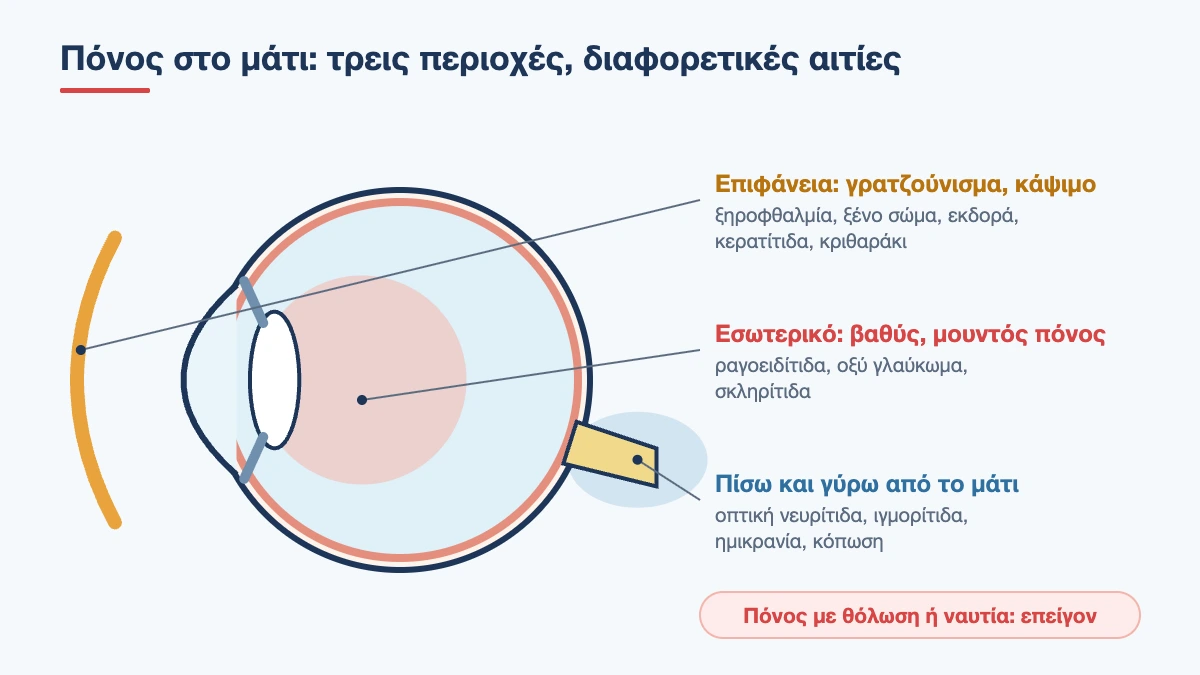
Eye pain can come from the surface of the eye, from inside it or from the structures around and behind it, and the type of pain often gives away the cause. Stinging and a scratchy feeling usually point to a problem on the surface, such as dryness or a foreign body. A deep, dull ache that gets stronger in light or with eye movement points to inflammation inside the eye or in the optic nerve. Pain together with a red eye, blurred vision or nausea needs an examination the same day.
How to describe your pain
In the clinic, the first questions are always about the type of pain. If you have thought about them beforehand, the diagnosis is made more quickly:
- Where exactly does it hurt? On the eye, deep inside, behind it, on the eyelid, on the forehead?
- What kind of pain is it? Scratching, burning, stabbing, pressure, throbbing?
- When does it get worse? When you blink, in light, when you move your eyes, when you bend down, at night?
- What else is there? Redness, watering, discharge, blurring, headache, fever?
- Do you wear contact lenses? Was there a blow, work with a grinder or an operation beforehand?
Pain on the surface of the eye
The cornea has more nerve endings than any other tissue in the body, which is why even a microscopic injury causes disproportionately intense discomfort. Surface pain has two hallmarks: it gets worse with every blink, and it eases dramatically, for a few minutes, with a drop of anaesthetic in the clinic.
Dry eye
The most common cause. Burning, stinging and a gritty, sandy feeling in both eyes, worse in the afternoon, at a screen, in air conditioning and in the wind. See the page on dry eye.
Foreign body and corneal abrasion
A metal filing, a grain of sand, a child’s fingernail, the edge of a piece of paper or a twig. The pain is sharp, the eye waters constantly and cannot stay open in the light. If you feel that something scratches with every blink, a particle may be lodged under the upper eyelid. Abrasions usually heal in 1 to 3 days with antibiotic ointment. If you were working with a grinder, a hammer or a strimmer, the eye needs to be checked for a particle that has penetrated it, even if the pain is mild.
Keratitis
Infection or inflammation of the cornea, with intense pain, a red eye, sensitivity to light and blurring. In contact lens wearers it is an emergency until proven otherwise. More detail on the page on keratitis and in the article on herpes in the eye.
Ultraviolet burn
The pain starts 6 to 12 hours after welding without a mask, a day in the snow or a sunbed, often during the night, and in both eyes. It is very intense but passes in 24 to 48 hours.
Conjunctivitis
It causes stinging and discomfort, not true pain. If a “red, sticky eye” genuinely hurts, the problem has reached the cornea. See the page on conjunctivitis.
Eyelids
A stye is tender to the touch at a specific point on the eyelid, where there is a red lump. An eyelash that turns inwards or an entropion causes constant scratching.
Pain deep inside the eye
Deep pain does not change with blinking and does not ease with an anaesthetic drop. It is dull, like pressure or tightness, and often spreads to the eyebrow and temple.
Uveitis
Inflammation of the iris and the surrounding tissues. The pain gets stronger in light and when you try to read, because the inflamed muscles contract. The eye is red around the coloured part and vision is blurred. More on eye inflammation.
Acute angle-closure glaucoma
The most intense pain the eye can produce. It comes on suddenly, often in the evening, with a very red eye, blurred vision, haloes around lights, headache and vomiting. The eye pressure has risen to several times its normal level and must be lowered within hours. In contrast, common chronic glaucoma causes no pain at all. Read about what raises eye pressure.
Scleritis
Inflammation of the wall of the eye, with a deep, boring pain that wakes the patient at night and gets worse when the eye is touched through the eyelid. It is often linked to rheumatoid arthritis and other autoimmune diseases.
Optic neuritis
Pain behind the eye that gets stronger when you move it, followed within a few days by blurring and fading of colours in one eye. From the outside the eye is white and quiet. More detail in the article on optic neuritis.
Infection after surgery
Increasing pain, redness and loss of vision in the first days after cataract surgery or an intravitreal injection is always urgent, and you should contact your surgeon immediately, even at night.
Pain around and behind the eye
Very often the eye hurts without the eye itself being at fault. The examination is normal and the cause lies nearby.
- Sinusitis: pressure and heaviness around the eyes, on the forehead and on the cheekbones, which gets worse when you bend down, with a blocked nose
- Migraine: throbbing pain around or behind one eye, with nausea and sensitivity to light and sound, lasting for hours
- Cluster headache: extremely severe pain behind one eye, in attacks lasting 15 minutes to 3 hours, often at night, with a red, watering eye, a drooping eyelid and a runny nose on the same side
- Eye strain: heaviness and pain around the eyes after many hours of close work, due to uncorrected long-sightedness, astigmatism, presbyopia or glasses with the wrong prescription. It eases with rest. See how screens affect the eyes
- Shingles (herpes zoster): burning pain on the forehead and around the eye, a few days before blisters appear on one side. Antiviral treatment is needed within the first 72 hours
- Trigeminal neuralgia: momentary stabbing pains, like an electric shock, in the face
- Orbital cellulitis: pain, swollen red eyelids, fever, an eye that bulges or has difficulty moving. It is an emergency, especially in children
- Thyroid eye disease: a feeling of pressure behind the eyes and pain on eye movement. See the article on the thyroid and the eyes
- Giant cell arteritis: after the age of 60, pain in the temples and in the jaw when chewing, with fatigue. It threatens sight and needs immediate treatment
Quick guide
| What the pain is like | What we think of first | How urgent |
|---|---|---|
| Burning and grittiness, in both eyes | Dry eye | Routine appointment |
| Sharp scratching with every blink | Foreign body, abrasion | Same day |
| Pain and a red eye in a contact lens wearer | Keratitis | Same day |
| Deep pain that gets worse in light | Uveitis | Same day |
| Pain on eye movement, blurring | Optic neuritis | Within 24 hours |
| Very severe pain, haloes, vomiting | Acute glaucoma | Immediately |
| Pressure around the eyes when bending down | Sinusitis | Routine appointment |
When eye pain is an emergency
- with blurred vision or loss of vision
- with a very red eye
- with nausea, vomiting or haloes around lights
- after a blow, a penetrating object or a chemical
- if you wear contact lenses
- if you have had eye surgery in the last few weeks
- if the eye bulges, does not move normally or you see double
- if there is fever and swollen eyelids
- if it is so severe that it keeps you awake
First aid
- Chemical: rinse immediately with plenty of running water for at least 15 minutes, holding the eyelids open, then go to the doctor with the product packaging
- Dust or sand: rinse with saline or water and blink. Do not rub
- Object stuck in the eye: do not touch it and do not press. Cover the eye loosely, for example with a paper cup, and go to hospital
- Contact lenses: remove them and keep them in their case
- For the pain: paracetamol by mouth, a cold compress and sunglasses
What to avoid
- anaesthetic drops at home. They give brief relief but prevent healing and mask any worsening
- steroid eye drops without an examination
- bandaging the eye tightly with gauze, especially if you wear contact lenses
- trying to remove a foreign body with tweezers or a cotton bud
- driving with one eye closed
How the diagnosis is made
After taking your history, we measure your vision and examine the eye with the slit lamp. A drop of dye reveals abrasions and ulcers on the cornea, and the upper eyelid is turned over to check whether anything is underneath. We measure the eye pressure, check the pupils, eye movements and colour vision, and examine the optic nerve. If the eye is normal, the investigation turns to the sinuses or to headache disorders, in collaboration with an ENT specialist or a neurologist.
Book an appointment
Eye pain that lasts more than a day, keeps coming back or comes with any other symptom is worth an examination. For pain with a red eye, blurring or an injury, call so that we can see you straight away. The practice is in Neo Psychiko, Athens, telephone 210 677 0007.
Frequently Asked Questions about Eye Pain
Why does my eye hurt when I move it?
Pain on eye movement usually points to inflammation behind the eyeball. The most typical cause is optic neuritis, especially if vision is also blurred. Other causes are sinusitis, scleritis and thyroid eye disease. An examination is needed within 24 hours.
Eye pain and headache together: what could it be?
It is usually migraine, sinusitis or eye strain. However, if the pain is very severe, with a red eye, blurred vision, haloes and nausea, it may be acute glaucoma, which requires immediate treatment.
Can eye pressure cause pain?
Common chronic glaucoma does not hurt, even with raised pressure, which is why it is only diagnosed with a check-up. Pain is caused by the sudden, very large rise in pressure in acute angle-closure glaucoma.
What should I do if something gets in my eye?
Rinse with plenty of saline or water and blink, without rubbing. If the feeling persists, there is probably a particle under the eyelid or an abrasion, and an examination is needed the same day. If it is a chemical, rinse for 15 minutes before you set off.
My eye hurts from the screen. Is it dangerous?
No. Long hours of screen work cause dryness and fatigue of the focusing muscles, which lead to burning, heaviness around the eyes and headache. Frequent breaks, artificial tears and a check for glasses all help.
Can I use anaesthetic drops to stop the pain?
No. They are used only in the clinic for the examination. Repeated use prevents the cornea from healing and can cause a serious ulcer, while also masking any worsening.
Questions about your case?
Dr. Skouteris will examine you at his practice in Neo Psychiko and explain your options.

Ophthalmic surgeon trained at the John Radcliffe University Hospital in Oxford and Fellow of the European Board of Ophthalmology (FEBO).
Full profile