Page contents
- How Does the Virus Reach the Eye?
- Types and Symptoms of Eye Herpes
- Why Is Eye Herpes Considered Serious?
- The Biggest Mistake: Steroids Without a Diagnosis
- Diagnosis
- Treatment of Eye Herpes
- Is It Contagious?
- How to Reduce Recurrences
- Shingles in the Eye: a Different Condition
- When to Be Examined Urgently
- Frequently Asked Questions about Eye Herpes
Eye herpes is an infection with the herpes simplex virus, the same virus that causes cold sores. It usually affects one eye, mainly the cornea, and shows up as redness, watering, sensitivity to light and a feeling that something is in the eye. It is treated effectively with antiviral medicines, but the virus never leaves the body and can come back. Every recurrence risks leaving a scar, which is why prompt diagnosis and avoiding steroids without medical advice matter so much.
How Does the Virus Reach the Eye?
Most people come into contact with herpes simplex virus type 1 in childhood, usually without noticing or with a simple mouth infection. After the first infection the virus is not cleared. It travels along the nerves and settles in a dormant (latent) form in a ganglion of the trigeminal nerve, which supplies sensation to the whole face, the lips and also the eye. There it stays inactive for years.
At some point it reactivates and travels back down the nerve towards the surface. If it follows the branch to the lips, the familiar cold sore appears. If it follows the branch to the eye, it affects the eyelids, the conjunctiva or the cornea. So eye herpes is not usually a new infection caught from someone else. It is the reawakening of a virus you already had.
What triggers it
- fever and infections, such as flu
- strong sun exposure
- physical or emotional stress and lack of sleep
- injury or surgery to the eye, including laser
- steroids, as eye drops or tablets, and other immunosuppressants
- hormonal changes, such as menstruation
- a weakened immune system
Often no trigger is found.
Types and Symptoms of Eye Herpes
Herpes can affect different parts of the eye, and the picture changes accordingly. What they have in common is that it almost always affects only one eye.
Eyelids and conjunctiva
Small blisters with clear fluid on the skin of the eyelids or along the lid margin, which burst, crust over and heal within 1 to 2 weeks without a mark. The eye may be red and watery, and the gland in front of the ear is often swollen. This is the usual picture of the first infection in children.
Epithelial keratitis
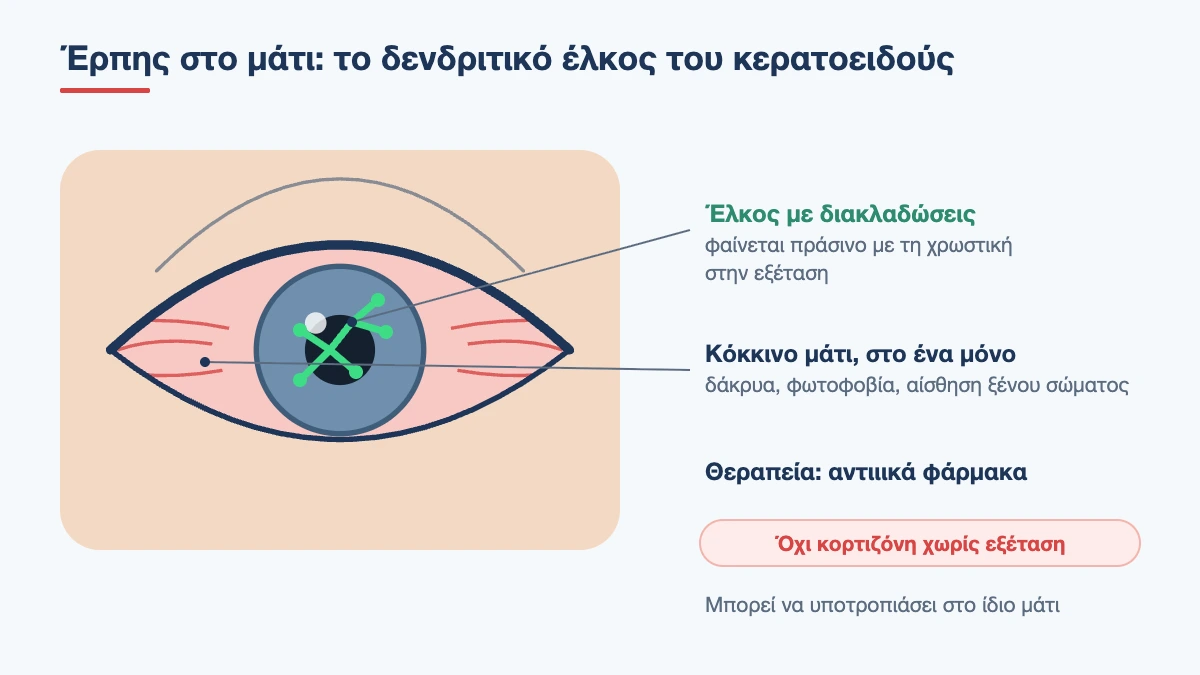
The most common and most characteristic form. The virus multiplies in the surface layer of the cornea and forms a fine, branching ulcer, like the branch of a tree (a dendritic ulcer), which shows up clearly when stained with dye. The symptoms are:
- a red eye
- a foreign body sensation or scratchiness
- watering with a watery discharge, not pus
- sensitivity to light (photophobia)
- blurred vision, if the ulcer is in the centre
The pain is often less than you would expect, because the virus reduces the sensitivity of the cornea. This is misleading: an eye that does not hurt much does not mean the damage is small.
Stromal keratitis
This usually appears in recurrences. Here the damage is caused not so much by the virus itself as by the immune response, which causes inflammation in the deeper layers of the cornea. The cornea becomes hazy and swollen and, over time, develops blood vessels and scarring. Vision becomes more blurred, and this is the form responsible for permanent loss of vision from herpes.
Inflammation inside the eye
The virus can cause uveitis, with deep pain, photophobia and, characteristically, raised eye pressure. Very rarely it affects the retina, a serious condition with a rapid drop in vision.
Neurotrophic damage
After repeated episodes, the cornea loses its sensation and with it the signals it needs in order to heal. An ulcer that will not close may develop, with no active virus and no pain.
Why Is Eye Herpes Considered Serious?
A single episode of epithelial keratitis usually heals without leaving anything behind. The problem is recurrence. About 1 in 5 patients will have a new episode within two years, and the likelihood increases with each further episode. Each time, the cornea may lose a little of its clarity and sensitivity. Herpes remains one of the most common infectious causes of reduced vision from corneal damage in the developed world.
The Biggest Mistake: Steroids Without a Diagnosis
A red, irritated eye leads many people to reach for eye drops that “helped last time”, and these often contain a steroid. In epithelial herpes keratitis, steroids suppress the local defences, the virus multiplies unchecked and the fine dendritic ulcer turns into a large, deep ulcer within days. The paradox is that in the stromal form steroids are an essential part of treatment, but always together with an antiviral and with close monitoring. Only a slit lamp examination can tell the two apart.
Diagnosis
The diagnosis is usually clinical. At the slit lamp, a drop of dye reveals the dendritic ulcer, which is so characteristic that no further confirmation is needed. We also check the sensitivity of the cornea, which is reduced compared with the other eye, look for haze in the deeper layers or inflammatory cells inside the eye, and measure the pressure. A history of previous episodes in the same eye or of cold sores supports the diagnosis. In atypical cases a sample is taken from the surface of the eye to detect the genetic material of the virus.
Herpes is often mistaken at first for simple conjunctivitis. Three features should raise suspicion: it affects only one eye, there is photophobia, and it does not settle or keeps coming back.
Treatment of Eye Herpes
Epithelial keratitis
Antiviral treatment for 1 to 2 weeks, either as a gel applied to the eye five times a day or as tablets, which are just as effective and easier for many patients. The ulcer usually closes within 7 to 10 days. Preservative-free artificial tears are added and, if needed, drops that relieve pain by dilating the pupil. Steroids are not used.
Stromal keratitis and uveitis
Steroid eye drops to control the inflammation, together with an oral antiviral for protection. The steroid is tapered very slowly, over weeks or months, because stopping suddenly causes a flare-up. Some patients need a very low maintenance dose for a long time. If the eye pressure is raised, glaucoma drops are added.
Preventive treatment
For people with frequent recurrences or who have had stromal keratitis, a low-dose oral antiviral is given for a year or longer. Large studies have shown that this treatment cuts the risk of a new episode almost in half. It is well tolerated and only needs a dose adjustment in people with kidney problems.
When a scar remains
A scar in the centre of the cornea can be improved with special rigid contact lenses, which smooth out the surface. In severe cases a corneal transplant is performed, with long-term antiviral cover, because the virus can also recur in the graft.
Is It Contagious?
The virus spreads through direct contact with active lesions or with saliva and tears that contain it. However, because most adults already carry it, the risk to those around you is small. Care is needed with babies, people with weakened immunity and people with eczema. While the episode is active:
- wash your hands often and do not touch your eye
- use your own towel and pillowcase
- do not kiss babies and do not share cosmetics or eye drops
- do not wear contact lenses, and throw away the pair you were wearing when it started
- if you have a cold sore, do not touch your lips and then your eyes, and do not wet your contact lenses with saliva
How to Reduce Recurrences
- wear UV-protective sunglasses and a hat in strong sun
- look after your sleep and manage stress as far as possible
- tell every doctor that you have a history of eye herpes before they prescribe steroids in any form
- before cataract surgery or laser vision correction, mention your history. Preventive antiviral treatment is usually given around the time of surgery, and with active or recent disease laser treatment is postponed
- learn to recognise the first signs and do not wait. The earlier treatment starts, the less damage there is
- if you have been given preventive treatment, do not stop it on your own
Shingles in the Eye: a Different Condition
Shingles (herpes zoster) is caused by a different virus, the chickenpox virus, which also lies dormant in the nerves and reactivates, usually after the age of 50. When it affects the branch of the nerve that supplies the eye, burning pain and painful blisters appear on the forehead, the eyelid and the scalp, strictly on one side. Blisters on the tip or side of the nose mean a high chance that the eye itself will be affected too. Oral antiviral treatment must start within 72 hours of the rash appearing, and an eye examination is needed even if the eye looks calm. There is a vaccine for prevention, which is recommended for older adults.
When to Be Examined Urgently
- a red eye, in one eye only, with photophobia or blurred vision
- blisters on the eyelids or around the eye
- a history of eye herpes and any new symptom in the same eye
- worsening after starting steroid eye drops
- a painful rash on the forehead or nose
Eye herpes is not something that can wait until next week. Call 210 677 0007 and describe your symptoms, so that you can be examined the same day at the clinic in Neo Psychiko, Athens. See also the page on keratitis.
Frequently Asked Questions about Eye Herpes
Is eye herpes contagious?
The virus spreads through direct contact with active lesions, tears or saliva. However, most adults already carry it from childhood. Care is needed mainly with babies and people with weakened immunity: wash your hands often, use your own towel and avoid kissing while the episode is active.
How many days does it take to clear up?
The epithelial ulcer usually closes within 7 to 10 days with antiviral treatment, which continues for 1 to 2 weeks. The deeper forms need weeks to months of treatment, with a slow tapering of the drops.
Can a cold sore spread to the eye?
Yes. It is the same virus, living in the same nerve, and it can reactivate towards the eye. It can also be carried by the fingers. When you have a cold sore, do not touch your eyes and wash your hands well.
Can eye herpes be cured for good?
Each episode can be treated, but the virus stays dormant in the nerve and can come back. About 1 in 5 patients has a recurrence within two years. Preventive antiviral treatment cuts the risk almost in half.
Why are steroids not allowed?
In the surface form, steroids allow the virus to multiply and the ulcer grows quickly. In the deeper form they are essential, but only together with an antiviral and under monitoring. That is why they are never used without an examination.
Can I wear contact lenses if I have had eye herpes?
Not while the episode is active. After full recovery, their use is decided case by case, because the cornea may have reduced sensitivity and may not give early warning of a new problem.
Can I have laser eye surgery for short-sightedness with a history of herpes?
A history of eye herpes is a relative contraindication, because laser can reactivate the virus. In selected cases, after a long period without recurrence and with preventive antiviral treatment, surgery can be discussed.
Questions about your case?
Dr. Skouteris will examine you at his practice in Neo Psychiko and explain your options.

Ophthalmic surgeon trained at the John Radcliffe University Hospital in Oxford and Fellow of the European Board of Ophthalmology (FEBO).
Full profile