
Page contents
- What Are Posterior Chamber Intraocular Lenses?
- Intraocular Lenses and Presbyopia Correction
- What types of intraocular lenses are there?
- The Intraocular Lens Implantation Procedure
- Benefits of Intraocular Lenses for Correcting Presbyopia and Refractive Errors
- Possible Complications and Side Effects
- Conclusion
- In the Press
Presbyopia, myopia, hyperopia and astigmatism are common refractive problems that affect the vision and quality of life of millions of people. In recent years, intraocular lenses for presbyopia and other refractive errors, specifically posterior chamber IOLs (intraocular lenses), have offered a safe and effective way to correct these problems, providing long-lasting results and reducing the need for glasses or contact lenses.
What Are Posterior Chamber Intraocular Lenses?
Posterior chamber intraocular lenses are artificial lenses that are permanently implanted in the eye, replacing the natural lens. They are placed in the posterior chamber of the eye, behind the iris, and provide clear vision at different distances, depending on their type.
Intraocular Lenses and Presbyopia Correction
Presbyopia is a normal, age-related decline in the ability of the eye’s lens to focus up close. Modern multifocal and accommodating intraocular lenses can restore near, intermediate and distance vision, reducing the need for reading glasses.
What types of intraocular lenses are there?
Monofocal Intraocular Lenses
- The most common type. They provide clear vision at one distance only (distance or near).
- Ideal for people who do not mind wearing reading glasses.
Multifocal Intraocular Lenses
- Allow vision at different distances without the need for glasses.
- Use a special design that distributes light across multiple focal distances.
- May cause mild visual phenomena (glare and halos) or reduced contrast sensitivity.
Extended Depth of Focus Intraocular Lenses (EDOF)
- Offer a wider range of clear vision than monofocal lenses.
- Reduce the need for glasses in everyday life.
- Have a lower rate of visual phenomena than multifocal lenses.
Toric Intraocular Lenses
- Designed to correct astigmatism.
- Can be combined with a multifocal or monofocal design.
The Intraocular Lens Implantation Procedure
The operation to implant intraocular lenses is performed with phacoemulsification, the same technique used to remove cataracts:
- Local anaesthesia with eye drops.
- A small incision in the cornea (about 2.2 millimetres).
- Removal of the eye’s natural lens.
- Implantation of the intraocular lens with a special injector.
- Quick healing without stitches.
The whole procedure takes about 10 to 15 minutes per eye, is completely painless and recovery is quick, with most patients returning to their daily activities within a few days.
Benefits of Intraocular Lenses for Correcting Presbyopia and Refractive Errors
- A permanent solution without the need for glasses or contact lenses.
- Fast visual recovery with minimal post-operative discomfort.
- The ability to correct several refractive errors (myopia, hyperopia, astigmatism, presbyopia).
- No risk of cataract in the future, as the natural lens is completely replaced.
- Flexible options with different types of intraocular lenses tailored to the patient’s needs.
Possible Complications and Side Effects
Although the operation is safe, there are some risks:
- Glare and light reflections, especially with multifocal lenses.
- Dry eye, usually temporary.
- A small chance of post-operative infection or inflammation.
- Posterior capsule opacification, which can be corrected with a simple laser procedure (YAG laser).
Conclusion
Posterior chamber intraocular lens implantation is one of the most advanced methods for correcting presbyopia and other refractive errors. Depending on the patient’s needs, modern intraocular lenses can provide clear vision at all distances, significantly improving quality of life.
If you are considering this option, it is important to consult a specialist ophthalmologist, who will assess your needs and recommend the best option for your eyes.
In the Press
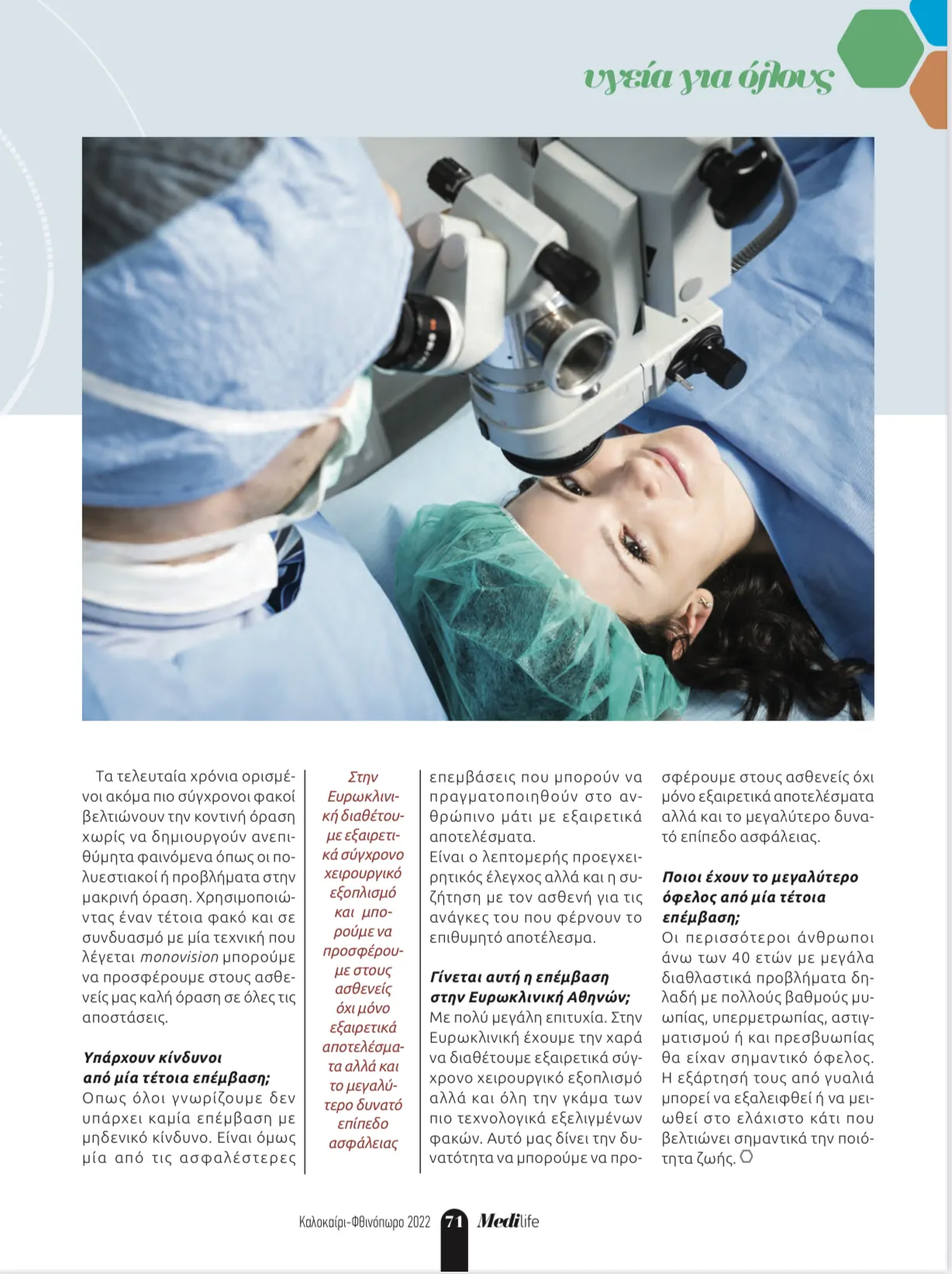
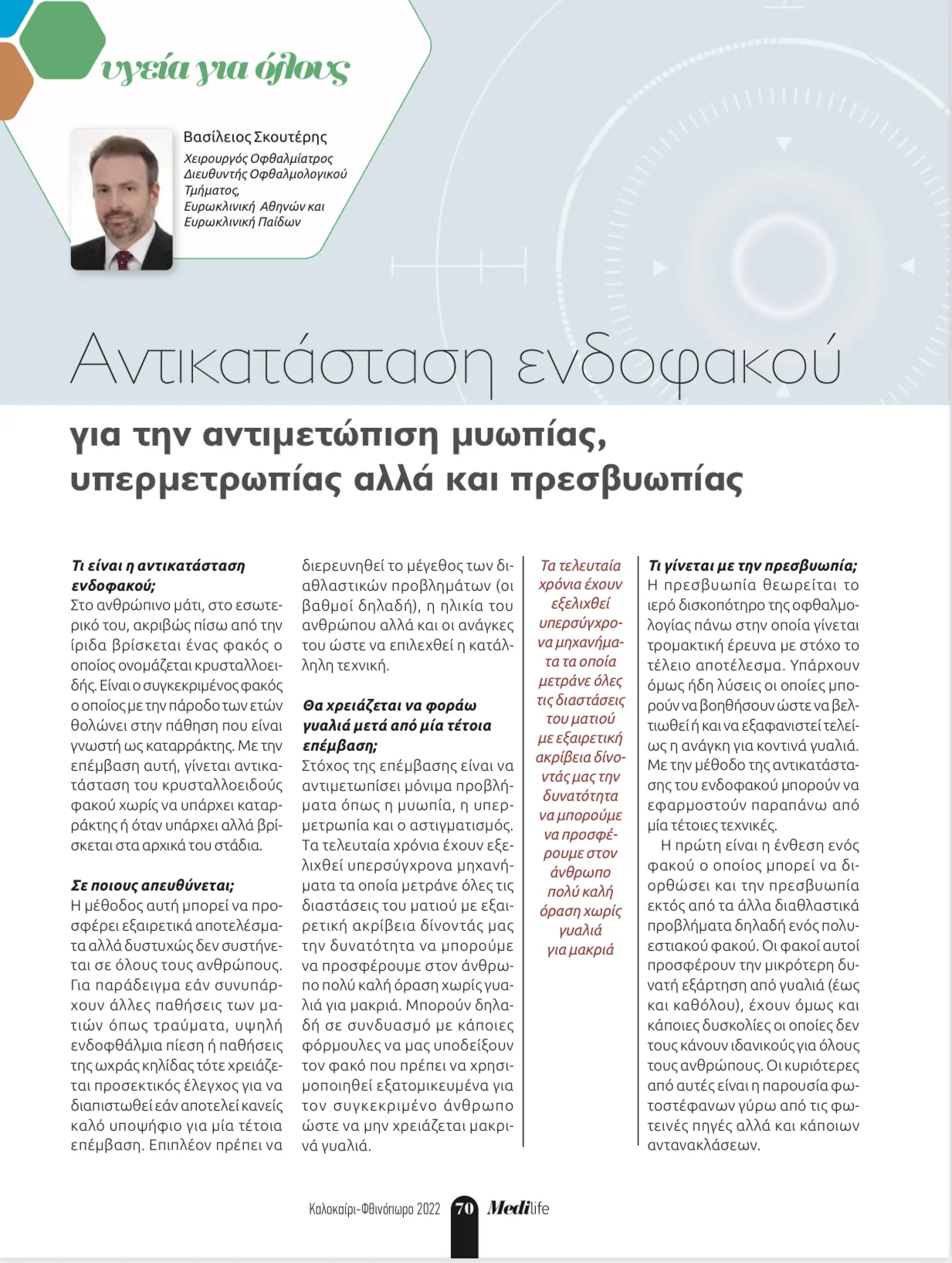
Dr Skouteris’s article on lens replacement for myopia, hyperopia and presbyopia, as published in a health magazine.
Questions about your case?
Dr. Skouteris will examine you at his practice in Neo Psychiko and explain your options.

Ophthalmic surgeon trained at the John Radcliffe University Hospital in Oxford and Fellow of the European Board of Ophthalmology (FEBO).
Full profile