
Written by Vasileios Skouteris MD, FEBO, Ophthalmic Surgeon
Page contents
- What is a subconjunctival haemorrhage?
- What it looks like and how it feels
- Causes: why does a blood vessel burst in the eye?
- Subconjunctival haemorrhage or something else? How to tell a red eye apart
- When does a subconjunctival haemorrhage need urgent examination?
- Diagnosis
- Treatment
- Everyday life while you have a subconjunctival haemorrhage
- Five common myths about subconjunctival haemorrhage
- Subconjunctival haemorrhage after surgery or an injection: what is normal?
- What the ophthalmologist will ask you
- Athletes, divers and subconjunctival haemorrhage
- Prevention
- Subconjunctival haemorrhage in children and in pregnancy
- When to book an appointment
- Frequently Asked Questions about Subconjunctival Haemorrhage
A subconjunctival haemorrhage is a small bleed under the conjunctiva, the clear membrane that covers the white of the eye. It appears suddenly as a bright red patch and alarms anyone who sees it in the mirror, but in the vast majority of cases it is completely harmless: it does not hurt, does not affect vision and clears on its own within 1 to 3 weeks, without treatment. Care is needed when it comes with pain or reduced vision, follows an injury or keeps recurring.
What is a subconjunctival haemorrhage?
The conjunctiva is a thin, transparent membrane that covers the sclera, the white wall of the eye, and folds back to line the inner surface of the eyelids. It contains many tiny blood vessels with very thin walls. When one of them breaks, blood leaks into the space between the conjunctiva and the sclera. Because the conjunctiva is transparent and the background is white, even a drop of blood looks dramatic, like red ink on white paper.
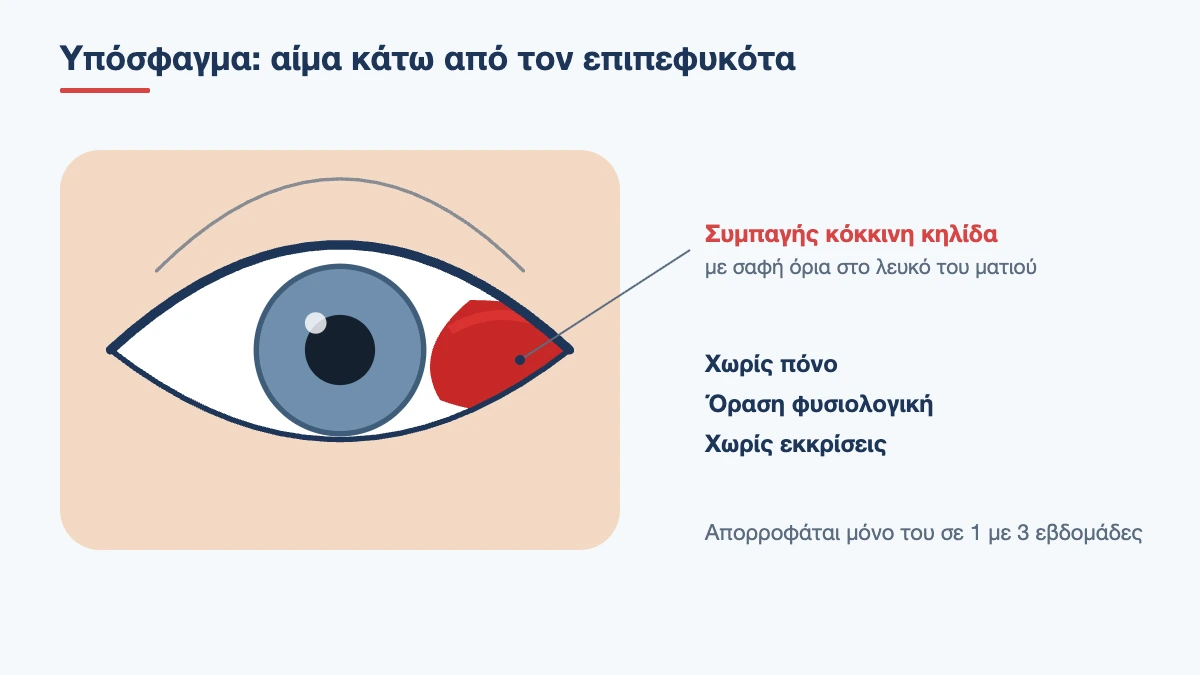
Essentially, it is a bruise. The difference from a bruise on your arm is that on the skin blood looks blue, because we see it through thick tissue, whereas on the eye it looks bright red, because nothing hides it. The blood lies outside the eye, on its wall. It does not enter the inside of the eye and does not touch the cornea, the lens or the retina, which is why it does not change your vision.
What it looks like and how it feels
- a red patch with clear edges on the white of the eye, from a small dot to the entire white
- the colour is even and dense; individual blood vessels cannot be seen within the patch
- the rest of the white of the eye is normal
- no pain at all. At most a slight feeling of heaviness or scratchiness, if the bleed is large and lifts the conjunctiva
- vision is the same as always
- there is no discharge, crusting or sensitivity to light
Most people do not notice it themselves. They see it in the mirror in the morning or someone else points it out. It often appears during sleep, and people cannot remember anything that caused it.
How it changes over the following days
In the first 24 hours the patch may get bigger, and this does not mean the vessel is still bleeding. The same blood spreads under the conjunctiva and, with gravity, moves down towards the lower part of the eye. It then changes colour, like any bruise: from bright red it becomes darker, then orange, and finally yellowish-green at the edges before it disappears. A small bleed clears in 5 to 7 days, a large one takes 2 to 3 weeks. It leaves no mark.
Book an appointment with the doctor
An examination and clear advice on your case at our practice in Neo Psychiko.
Causes: why does a blood vessel burst in the eye?
In about half of people no cause is found and the episode does not recur. In the rest, one of the following mechanisms is usually involved.
A sudden rise in venous pressure
Anything that suddenly raises the pressure in the head can burst a thin blood vessel: violent coughing, sneezing, vomiting, straining from constipation, lifting heavy weights, blowing your nose hard, even blowing up balloons or playing a wind instrument. That is why subconjunctival haemorrhage is common during flu and bronchitis season.
Minor injury
Rubbing the eyes hard is one of the most common causes, especially in people with allergies or dry eye. Inserting or removing contact lenses, a fingernail, a twig or a light knock you paid no attention to can do the same.
High blood pressure and diabetes
Uncontrolled blood pressure and diabetes mellitus make small blood vessels more fragile. A subconjunctival haemorrhage is sometimes what prompts someone to measure their blood pressure and discover that it is high. It does not mean a stroke is imminent, as many people fear, but it is a good reason for a check-up.
Medicines and supplements that affect blood clotting
Anticoagulants and antiplatelet drugs, such as aspirin, clopidogrel, warfarin-type drugs and the newer oral anticoagulants, do not cause bleeding on their own, but they make a leak that would otherwise go unnoticed larger and more visible. Anti-inflammatory painkillers and some supplements in high doses have a similar, milder effect, such as omega-3 fatty acids, vitamin E, ginkgo biloba and garlic supplements.
Age
Over the years the conjunctiva loosens and its blood vessels lose their elasticity, just as the skin on the hands bruises more easily. After 60, subconjunctival haemorrhage is clearly more common.
Eye surgery and injections
It is expected after cataract surgery, laser refractive surgery and, very often, after an intravitreal injection, at the spot where the needle went in. It makes no difference to the outcome of the treatment.
Less common causes
- viral conjunctivitis with small bleeds, although here the eye is irritated and has discharge
- clotting or platelet disorders
- tumours or vascular malformations of the conjunctiva
- childbirth: it is common both in the mother, from straining, and in the newborn, from pressure in the birth canal, and it clears without consequences
Subconjunctival haemorrhage or something else? How to tell a red eye apart
Not every red eye is a subconjunctival haemorrhage, and the distinction matters, because the other causes need treatment.
| Condition | What the redness looks like | Pain | Vision | Other features |
|---|---|---|---|---|
| Subconjunctival haemorrhage | Solid red patch with clear edges | No | Normal | No symptoms |
| Conjunctivitis | Diffuse pink or red, with visibly dilated blood vessels | Stinging, itching | Normal | Discharge, watering, often in both eyes |
| Episcleritis | A red sector, wedge-shaped | Mild tenderness | Normal | Tends to recur |
| Keratitis | Redness around the iris | Severe | Blurred | Photophobia, often contact lens wear |
| Uveitis | Redness around the iris | Deep ache | Blurred | Photophobia, small pupil |
| Acute glaucoma | Diffuse, dark red | Very severe | Very blurred, halos | Headache, nausea |
The practical rule is simple: a red patch without pain, without blurring and without discharge is almost always a subconjunctival haemorrhage. If even one of these three is present, you need an examination.
When does a subconjunctival haemorrhage need urgent examination?
In the following cases, do not wait for it to clear:
- After an injury, especially from a sharp or fast-moving object, or a hard blow. A large bleed that covers the whole white of the eye and whose back edge cannot be seen may hide a rupture of the eye wall or a fracture of the eye socket
- If the eye hurts or is sensitive to light
- If your vision has become blurred or you see double
- If you see blood in front of the coloured part of the eye, that is, inside the eye rather than on the white
- If there is discharge or the eye is red all over
- If it appeared in both eyes at the same time or together with bruises on the body, or bleeding from the gums or nose
- If you take warfarin or a similar anticoagulant and have not had your INR checked recently
- If it has not started to fade after 2 weeks or has not cleared after 3 to 4
- In a baby or young child with no obvious explanation, other than in the first days after birth
Diagnosis
Diagnosis is made with a quick look at the slit lamp. The ophthalmologist confirms that the blood lies under the conjunctiva, that the cornea and the inside of the eye are clear and that there is no injury or foreign body. Your vision and intraocular pressure are measured. If there was a blow to the eye, the retina is also examined with dilated pupils.
For a first, isolated episode with no other findings, no blood tests are needed. It is still worth measuring your blood pressure if you have not done so recently.
When it keeps recurring
Two or three episodes within a year, or bleeds that appear for no reason at all, justify a basic check-up in collaboration with your GP or cardiologist:
- blood pressure readings at different times of day
- a full blood count with platelets
- clotting times, and INR for those taking warfarin-type drugs
- blood sugar and HbA1c (glycated haemoglobin)
- a review of all medicines and supplements
When examining the eye we look for local causes that explain the recurrences: a loose conjunctiva that forms folds and rubs with every blink (conjunctivochalasis), dry eye that leads to rubbing, blepharitis or an abnormal blood vessel that always bleeds in the same place.
Treatment
A subconjunctival haemorrhage needs no treatment, and nothing speeds up its absorption. The body clears the blood at its own pace. What you can do:
- Artificial tears, three to four times a day, if you feel scratchiness or a foreign body sensation
- A cold compress in the first 24 hours, if you find it soothing. It does not change the course
- Do not rub the eye
- For pain from another cause, choose paracetamol rather than aspirin or anti-inflammatories, for a few days
And what is not needed or does not help:
- Eye drops that “whiten” the eye have no effect. They constrict blood vessels, but here the blood is outside them
- Antibiotics have no role, since there is no infection
- Warm compresses, herbs and tea do not speed up absorption
- Do not stop an anticoagulant or aspirin on your own if you take it for your heart or blood vessels. The risk from stopping is far more serious than a bruise on the eye. If it worries you, speak to the doctor who prescribed it
Everyday life while you have a subconjunctival haemorrhage
You can work, read, drive, use screens and fly without any restriction. Light and moderate exercise is allowed. For two to three days it is sensible to avoid lifting very heavy weights and exercises with your head down, so that the bleed does not get bigger. Swimming is allowed with goggles.
If you wear contact lenses and the eye is not uncomfortable, they are not forbidden. However, when the bleed is large and the conjunctiva is raised, the lens may not sit well, and it is better to wear glasses for a few days. Make-up is not forbidden. It is not contagious and there is no reason for a child to stay off school.
The only real problem is cosmetic. A large red patch attracts attention and prompts questions, and unfortunately this lasts as long as the blood takes to be absorbed. Sunglasses help outdoors.
Book an appointment with the doctor
An examination and clear advice on your case at our practice in Neo Psychiko.
Five common myths about subconjunctival haemorrhage
- “A vein burst, so I am at risk of a stroke.” The blood vessels of the conjunctiva have nothing to do with those of the brain. A subconjunctival haemorrhage does not herald a stroke. If your blood pressure is high, however, it is worth getting it under control anyway
- “The blood will get inside the eye and damage my vision.” The space under the conjunctiva does not connect with the inside of the eye
- “I got it from tiredness and screen use.” Long hours at a screen do not burst blood vessels. They can, however, dry out your eyes and make you rub them, and rubbing is a real cause
- “It got bigger on the second day, so it is getting worse.” The blood is simply spreading and moving down with gravity. This is expected and does not mean a new bleed
- “The doctor needs to drain it for it to go away.” No intervention is carried out. Absorption is a natural process and completes on its own
Subconjunctival haemorrhage after surgery or an injection: what is normal?
After cataract surgery, refractive surgery or an intravitreal injection, a red patch at the site of the procedure is very common, especially in people taking anticoagulants. In refractive surgery it is caused by the suction ring that stabilises the eye and can appear in both eyes. It does not affect the result and clears in 1 to 3 weeks. What is not normal after any procedure is pain that gets stronger, vision that gets worse instead of better, marked sensitivity to light and discharge. In that case, get in touch immediately, without waiting for your scheduled follow-up. You may also find the aftercare instructions following an intravitreal injection helpful.
What the ophthalmologist will ask you
To decide whether further tests are needed, it helps to have answers ready to a few questions: when you noticed it and whether it followed coughing, vomiting, lifting something heavy or a blow; whether this is the first time; whether you have high blood pressure or diabetes and when you last checked your blood pressure; which medicines and supplements you take; whether you bruise easily or your gums bleed; whether you wear contact lenses; and whether you often rub your eyes. If you have an anticoagulant monitoring card or recent blood test results, bring them with you.
Athletes, divers and subconjunctival haemorrhage
In weightlifting and endurance sports, subconjunctival haemorrhage is caused by holding your breath during maximum effort. In diving there is a specific mechanism: if the diver does not equalise the pressure inside the mask by breathing a little air out through the nose while descending, the mask acts like a suction cup on the eyes and bursts blood vessels in the conjunctiva and eyelids (mask squeeze). It looks dramatic but is harmless, and it is prevented with correct equalisation technique. In contact and ball sports, on the other hand, a subconjunctival haemorrhage after a blow should always be examined to rule out deeper damage.
Prevention
A single subconjunctival haemorrhage cannot be prevented. If it happens to you often, however, some measures reduce the chances:
- keep your blood pressure and blood sugar under control and do not skip doses of your medication
- do not rub your eyes. If you have itching from allergy or dryness, treat the cause
- use artificial tears if your eyes get dry
- treat chronic cough and constipation
- breathe out during the effort when lifting weights, rather than holding your breath
- wear protective glasses for work and sports with a risk of being hit
- put in and take out contact lenses with short nails and calm movements
- tell your doctor about any supplements you take, especially if you also take anticoagulants
Subconjunctival haemorrhage in children and in pregnancy
In children, subconjunctival haemorrhage is usually caused by severe coughing, as in whooping cough, by vomiting or by a knock during play, and it clears just as in adults. If there is no explanation at all or there are bruises elsewhere, the child should be examined by a paediatrician. In pregnancy it can appear from vomiting in the first trimester or during childbirth. It is harmless, but in the third trimester it is an opportunity to have your blood pressure checked.
When to book an appointment
If this is your first subconjunctival haemorrhage and you are not sure what you are looking at, a short examination will reassure you. If it comes with pain, blurring or discharge, or followed a blow, ask to be seen the same day. If it keeps recurring, it is worth having the surface of the eye checked and a basic medical check-up. Call the clinic in Neo Psychiko, Athens, on 210 677 0007 or use the contact form.
Recurring blood in the eye?
A short examination confirms that it is a subconjunctival haemorrhage and checks the cause. Book an appointment.
Frequently Asked Questions about Subconjunctival Haemorrhage
How long does a subconjunctival haemorrhage take to clear?
A small subconjunctival haemorrhage is absorbed in 5 to 7 days, while a large one may take 2 to 3 weeks. During this time it changes colour, from red to orange and yellowish, like any bruise. It leaves no mark and does not affect your vision.
Is blood in the eye dangerous?
When it is a red patch on the white of the eye, with no pain and normal vision, it is not dangerous. The blood lies under the conjunctiva, not inside the eye. You need an examination if there is pain, blurred vision or an injury, or if the blood is visible in front of the iris.
Does a subconjunctival haemorrhage mean I have high blood pressure?
Not necessarily. In about half of people no cause is found. High blood pressure does, however, make blood vessels more fragile, so a subconjunctival haemorrhage is a good reason to check your blood pressure, especially if it keeps happening.
Are there eye drops that make it clear faster?
No. No drop, ointment or compress speeds up absorption. Whitening eye drops have no effect, because the blood is outside the blood vessels. Artificial tears only help if there is a foreign body sensation.
Should I stop taking aspirin or my anticoagulant?
No, never on your own initiative. Stopping them can have serious consequences for your heart and blood vessels, whereas a subconjunctival haemorrhage is harmless. If the bleeds keep recurring, discuss it with the doctor who prescribes them so the dose can be reviewed.
Can I wear contact lenses or exercise?
If the eye is not uncomfortable, contact lenses are allowed, although with a large haemorrhage glasses are more comfortable for a few days. Light exercise is allowed. For two to three days, avoid very heavy weights and exercises with your head down.
Why does it keep happening to me?
Frequent recurrences are usually linked to eye rubbing, dry eye, loose conjunctiva, uncontrolled blood pressure, diabetes or medicines that affect blood clotting. An eye examination and basic blood tests are needed to find the cause.
Medically reviewed by: Dr. Vasileios Skouteris MD, FEBO