
Written by Vasileios Skouteris MD, FEBO, Ophthalmic Surgeon
Page contents
- What is amblyopia?
- Why is it called a “lazy eye”?
- When does it develop and why does age matter so much?
- Causes and types of amblyopia
- Which children are most at risk?
- Symptoms: what parents may notice
- How is amblyopia diagnosed?
- When should a child have an eye examination?
- Amblyopia treatment
- How long does treatment last and how is it monitored?
- Practical tips for patching
- Amblyopia in teenagers and adults
- What happens if it is not treated?
- When to book an appointment
- Frequently Asked Questions about Amblyopia (Lazy Eye)
Amblyopia, also known as lazy eye, is reduced vision in one eye (less often in both) because the brain did not learn to use it properly in the first years of life. The eye may look completely normal, but the image it sends is ignored. It affects about 2 to 4 in every 100 children and can be treated if it is diagnosed early, ideally before the age of 7.
What is amblyopia?
Vision is not fully developed at birth. A newborn sees blurrily and learns to see over the first months and years, as the brain receives clear images from both eyes and “builds” the nerve connections it needs. If, during this period, one eye sends a blurred, distorted or different image from the other, the brain favours the better eye and gradually “switches off” the signal from the other. This suppression is amblyopia.
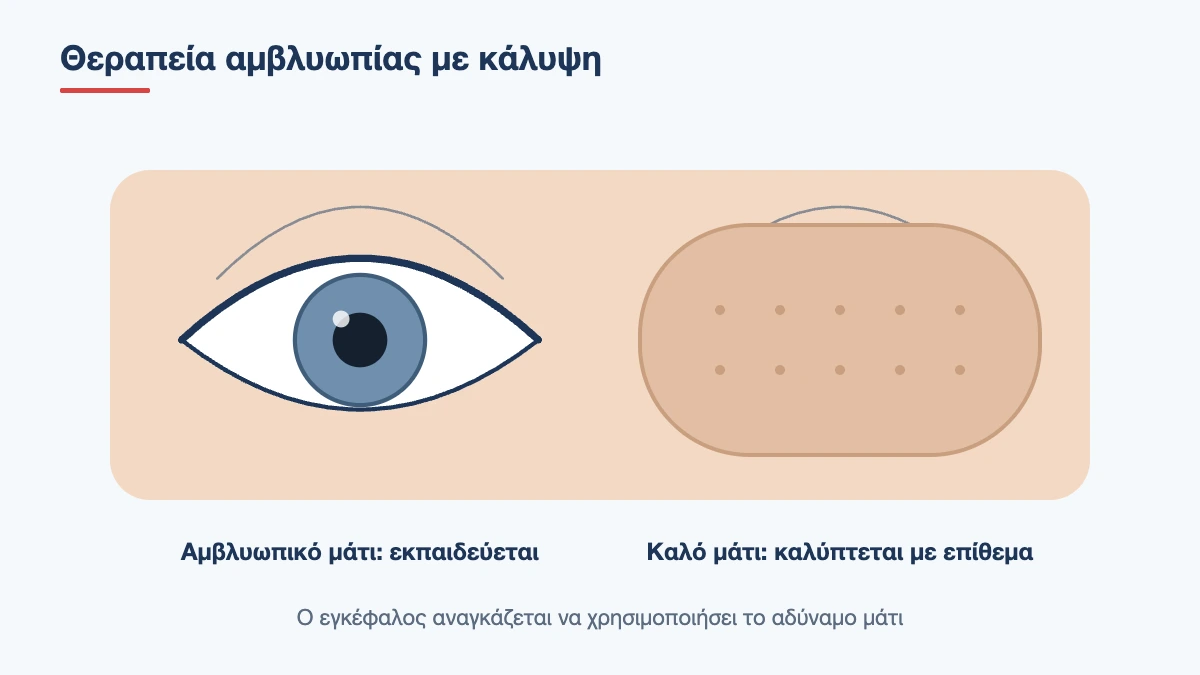
The key point is that the problem is not in the eye itself but in the way the visual pathway has developed. This is why vision is not fully corrected even with the right glasses: the lens makes the image clear, but the brain has not yet learnt to use it. It is also why treatment is essentially training, in other words we make the brain work with the weaker eye while it still has the plasticity to learn.
In the vast majority of cases, amblyopia affects one eye. Amblyopia in both eyes occurs when both eyes have a large refractive error that has been left uncorrected, or when something blocks light in both eyes, such as congenital cataract.
Why is it called a “lazy eye”?
The term is a popular one and a little unfair. The eye is not lazy; it simply has not been given the chance to develop. Parents often confuse a lazy eye with an eye that “wanders”, in other words with strabismus (squint). Strabismus is one of the causes of amblyopia, but it is not the same thing: there are children with perfectly straight eyes and severe amblyopia, and these are exactly the ones most often missed, because nothing shows from the outside.
Book an appointment with the doctor
An examination and clear advice on your case at our practice in Neo Psychiko.
When does it develop and why does age matter so much?
Visual development has a sensitive period that starts at birth and lasts until about 7 to 8 years of age, with the first months and the first 2 to 3 years being the most decisive. Within this window the brain is extremely adaptable, which works in both directions: amblyopia sets in easily, but it is also treated easily.
As the child grows older, the response to treatment becomes slower and less complete. This does not mean nothing can be done after the age of 7. Large clinical studies have shown that children aged 7 to 12 improve substantially with glasses and patching, and that even teenagers who have never been treated can gain lines of vision. The realistic message for parents is twofold: the earlier the better, but we never rule out an attempt because “the age has passed” without first examining the child.
Causes and types of amblyopia
Anything that stops one eye from sending a clear image during the sensitive period can cause amblyopia. In practice we distinguish three main mechanisms, which often coexist.
| Type | What happens | How easily it is noticed |
|---|---|---|
| Strabismic | One eye turns and the brain suppresses it to avoid double vision | Parents usually notice it |
| Anisometropic (refractive) | The two eyes have different prescriptions and one constantly sees blurred | Almost never, the child seems to see perfectly well |
| Deprivation | Something covers or clouds the visual axis, such as a cataract or a drooping eyelid | Depends on the cause |
Strabismic amblyopia
When the eyes are not aligned, each looks in a different direction and the brain should see two images. In children, the brain solves the problem by ignoring the eye that turns. If it is always the same eye that turns, that eye becomes amblyopic. If the eyes alternate, in other words sometimes one turns and sometimes the other, the risk is lower, because both eyes get “practice”. Esotropia, an eye that turns towards the nose, is more often associated with amblyopia than exotropia.
Anisometropic amblyopia
This is the most insidious form. One eye has noticeably more hyperopia (long-sightedness), astigmatism or myopia (short-sightedness) than the other. The child sees comfortably with the good eye, plays, draws, recognises faces and nobody suspects anything. It is usually discovered by chance, when someone covers the good eye, or at the first proper eye examination. A difference in hyperopia of just 1 to 1.5 dioptres between the two eyes is enough to cause a problem.
Deprivation amblyopia
This is the rarest but also the most severe form, because the eye receives no formed image at all. The most common causes are congenital cataract, marked congenital ptosis (drooping eyelid) that covers the pupil, corneal clouding or a haemangioma of the eyelid. Here time is measured in weeks: a dense cataract in one eye must be operated on within the first 6 to 8 weeks of life for the eye to have a chance of good vision.
Bilateral refractive amblyopia
Children with high hyperopia or high astigmatism in both eyes who have never worn glasses may have moderately reduced vision in both eyes. This form usually responds very well to the correct glasses prescription alone and a few months of patience.
Which children are most at risk?
Amblyopia can occur in any child, but it is more likely when there is:
- a family history of amblyopia, strabismus or glasses from a very young age in parents or siblings
- premature birth or low birth weight
- developmental delay or a neurological condition
- a congenital eye condition, such as cataract, glaucoma or a drooping eyelid
- an eye that turns after the first 4 months of life
These children should ideally be examined earlier rather than waiting for the preschool check.
Symptoms: what parents may notice
A child with amblyopia rarely complains. They do not know what it is like to see well with both eyes, so they have nothing to compare with. The signs are indirect and worth keeping in mind:
- an eye that turns inwards, outwards or upwards, all the time or when the child is tired
- closing or squinting one eye, especially in bright light
- tilting or turning the head when looking at something closely
- strong protest when you cover one eye, but no reaction when you cover the other
- clumsiness, tripping, difficulty catching a ball or going down stairs, which point to poor depth perception
- holding books or screens very close
- an eyelid that droops and covers part of the pupil
- a whitish or uneven reflection in the pupil in flash photographs
The last point needs particular attention: a white pupil in a photograph is never something that can wait and needs an examination within a few days.
A simple test at home
While your child is looking at something that interests them, gently cover first one eye and then the other with your palm. If they carry on undisturbed with one eye covered, but push your hand away, cry or try to look around it when the other eye is covered, the eye left uncovered at that moment may be the one that sees worse. The test does not replace an examination and a normal result does not rule out amblyopia, but an abnormal one is a good reason to book an appointment without delay.
How is amblyopia diagnosed?
The diagnosis is made with a full paediatric eye examination, adapted to the child’s age and cooperation. The child does not need to know letters or even be able to talk.
Measuring visual acuity
In babies, we check whether each eye fixes on and follows an object and whether there is a preference for one eye. From about 2.5 to 3 years we use charts with shapes or pictures that the child names or matches with a card in their hands, and later the letter E in different directions, or numbers. Each eye is tested separately. We consider amblyopia to be present when the vision in one eye is two or more lines worse than the other, or than expected for the child’s age, despite the correct prescription.
Refraction with eye drops
Children have very strong accommodation, meaning their eyes “zoom” on their own and mask hyperopia. To measure the true prescription we use cycloplegic drops, which temporarily relax this mechanism and dilate the pupil. The child’s near vision is blurred and they are sensitive to light for a few hours. This is the most important step of the examination, because without it the correct prescription cannot be given.
Checking eye alignment and the fundus
With the cover test we check for strabismus, even a very small one that cannot be seen with the naked eye. With the pupils dilated we examine the lens, the retina and the optic nerve, to rule out structural damage that would explain the poor vision. Amblyopia is in a sense a diagnosis of exclusion: we make it when there is a cause that explains it and the eye is otherwise healthy. In older children, stereoscopic (3D) vision is also tested.
When should a child have an eye examination?
Because amblyopia causes no symptoms, the only way to find it is to look for it. A practical screening schedule is as follows:
- At birth and in the first months: red reflex check by the paediatrician, to rule out cataract or other clouding
- At 6 to 12 months: examination if there is a family history, premature birth or anything that worries the parents
- At 3 to 4 years: first full examination with vision testing in each eye and refraction with drops, for all children
- Before primary school: a follow-up check, so that the child starts school with the right vision
You can find more about what each visit involves in the article on the eye examination before starting school.
Amblyopia treatment
Treatment always follows the same logical sequence: first we remove anything that prevents a clear image, then we give the eye the right glasses and, if needed, we make the brain use it. The plan is individual and changes according to age, the depth of the amblyopia and the response.
Step 1: treating the cause
If there is a cataract, a drooping eyelid covering the pupil or another obstacle, it is treated first, because no exercise works as long as the eye is not receiving an image.
Step 2: glasses
The right glasses, worn during all waking hours, are the foundation of treatment. Many parents are surprised to learn that glasses alone significantly improve amblyopia: in a large proportion of children with anisometropia, vision improves within 3 to 4 months, and in about one in three the amblyopia resolves completely without anything else being needed. This is why we usually wait for this adjustment period before deciding on patching.
Step 3: patching the good eye
If a difference remains after glasses, we cover the good eye with an adhesive patch so that the amblyopic eye has to work. The many hours of patching used in the past are usually not necessary. For moderate amblyopia, 2 hours a day are generally enough, while in more severe forms we start with about 6 hours. The patch is stuck to the skin and not to the glasses, because otherwise the child looks around the side. Patching time is most effective when the child is doing something that needs attention to detail: drawing, puzzles, building toys, reading.
Alternative: atropine eye drops
For children who do not tolerate the patch, there is what is known as penalisation. One drop of atropine in the good eye blurs its near vision, so the child is forced to use the weaker eye for close work. In moderate amblyopia, atropine gives results comparable to patching, and often drops at weekends only are enough. It causes sensitivity to light, so a hat and sunglasses are needed, and it is not suitable in every case.
Digital and binocular treatments
In recent years, games and videos have been developed that show a different image to each eye, with the aim of making both eyes work together. The idea is attractive, but the evidence so far is mixed and they have not been shown to be better than conventional methods. We see them as a possible addition in selected children, not as a replacement for glasses and patching. The same applies to the “eye exercises” found online: on their own they do not cure amblyopia.
What about strabismus?
When strabismus is also present, the amblyopia is treated first and then, if needed, the position of the eyes is corrected surgically. The operation aligns the eyes but does not by itself improve the vision of the amblyopic eye.
Book an appointment with the doctor
An examination and clear advice on your case at our practice in Neo Psychiko.
How long does treatment last and how is it monitored?
Most families should expect months rather than weeks. The child is usually re-examined every 6 to 12 weeks. At each visit we measure the vision of both eyes, because on rare occasions excessive patching can reduce the vision of the good eye, which is easily corrected if we spot it in time. The greatest improvement comes in the first 3 to 4 months, after which progress slows down.
When vision has stabilised, patching is not stopped abruptly but reduced gradually. About one in four children shows some recurrence in the first year after stopping, and gradual tapering reduces this risk. Monitoring continues until about the age of 10, when vision is considered established.
Practical tips for patching
The success of treatment is decided at home. Patching fails far more often because it is not done than because it does not work. A few things that help families:
- Put the patch on at a fixed time of day, so that it becomes a routine and not a daily negotiation
- Combine it with an activity your child enjoys. Half an hour of a favourite game on the tablet with the patch on is worth more than two hours of arguing
- Let your child choose patches with designs and use a sticker chart for every day completed
- Let the teacher or nursery staff know. If patching takes place at school, a simple explanation to the class prevents teasing
- If the skin gets irritated, change the brand of patch, shift its position slightly and apply moisturiser in the evening
- In the first few days the child genuinely sees poorly with the weaker eye and it is natural for them to resist. Resistance usually fades once vision starts to improve
If, despite your efforts, patching is not happening, say so openly at the next visit. There are alternatives, and it is better to change the plan than to lose time.
Amblyopia in teenagers and adults
In adults, amblyopia that was not treated in childhood is generally permanent. There are research efforts with binocular training that show small improvements in some people, but at present there is no treatment with a consistent and predictable result. There are two things worth knowing.
First, refractive laser eye surgery does not cure amblyopia. It can free the eye from glasses, but vision will only reach the level it reached with the best correction. Second, anyone with an amblyopic eye essentially relies on the other eye, so they have every reason to protect it: protective eyewear for work and sports with a risk of injury, and regular eye examinations throughout life.
What happens if it is not treated?
Untreated amblyopia means permanently reduced vision in one eye and loss of stereoscopic vision, in other words fine depth perception. In daily life most people adapt well, but certain professions that require good vision in both eyes are ruled out, and the risk of serious visual disability if something happens to the good eye is clearly higher throughout life. This is the real reason we insist on early diagnosis.
When to book an appointment
Do not wait for the scheduled check if you notice an eye that turns after the fourth month, an eyelid that covers the pupil, a white reflection in a photograph, a constant preference for one eye, or if there is amblyopia in the family. At the practice in Neo Psychiko we examine children of all ages with methods adapted to their level of cooperation. Book an appointment on 210 677 0007 or through the contact form.
Worried about your child's eyesight?
Amblyopia can be treated when it is diagnosed early. Book a paediatric eye examination in Neo Psychiko.
Frequently Asked Questions about Amblyopia (Lazy Eye)
Up to what age can amblyopia be treated?
The best results come when treatment starts before the age of 7, because the brain is more adaptable at that stage. However, children aged 7 to 12 improve substantially with glasses and patching, and even teenagers who have never been treated may benefit. It is always worth having an examination before ruling out treatment because of age.
How many hours a day should the good eye be covered?
It depends on the severity. In moderate amblyopia, 2 hours a day are usually enough, while in severe amblyopia we start with about 6 hours. The exact plan is set by the ophthalmologist and adjusted at each follow-up visit according to the child’s progress.
Are glasses alone enough to correct a lazy eye?
In many children, yes. The right glasses, worn all day, significantly improve vision within 3 to 4 months, and in about one in three children the amblyopia resolves completely. If a difference remains between the two eyes, patching or atropine drops are added.
Is amblyopia the same as strabismus?
No. Strabismus is misalignment of the eyes, while amblyopia is reduced vision in one eye because the brain does not use it. Strabismus can cause amblyopia, but many children have amblyopia with perfectly straight eyes, usually because of a difference in prescription between the eyes.
Can amblyopia come back after treatment?
Yes, about one in four children shows some decline in vision in the first year after patching stops. This is why treatment is tapered gradually and the child is monitored regularly until about the age of 10. If there is a recurrence, patching is restarted and vision usually recovers.
Can laser treatment cure amblyopia in adults?
No. Laser corrects the refractive error, in other words myopia, hyperopia or astigmatism, but it does not change the way the brain processes the image. After surgery, the amblyopic eye will see as well as it did before with its best glasses.
Are screens harmful for a child with amblyopia?
Screens do not cause amblyopia. On the contrary, a game or a video on a tablet during patching time can help, because it keeps the child focused on detail with the weaker eye. Outside treatment, the general recommendations for limited screen time and plenty of outdoor play apply.
Medically reviewed by: Dr. Vasileios Skouteris MD, FEBO