Page contents
Red eyes are caused by dilation of the tiny blood vessels on the surface of the eye, and in most cases the cause is harmless: dryness, tiredness, allergy or simple conjunctivitis. There are, however, causes that threaten sight. Three signs set them apart: genuine pain, blurred vision and marked sensitivity to light. If you have even one of these, or if you wear contact lenses, you need an examination the same day.
Why does the eye go red?
The white of the eye is covered by the conjunctiva, a transparent membrane full of fine blood vessels that are normally not visible. When the surface becomes irritated, dry, infected or inflamed, these vessels dilate to bring more blood and immune cells, and the eye turns pink or red. Redness is therefore not a condition but a symptom, like a fever. The intensity of the colour does not show how serious the problem is. A dramatically red eye can be completely harmless, while a moderately red eye with pain can be urgent.
Common, harmless causes
Dry eye and screen fatigue
This is the most common cause of chronic, mild redness in both eyes. When we look at a screen we blink less than half as often, the tears evaporate and the surface dries out. The eyes sting, burn, go red towards the afternoon and blur temporarily. Air conditioning, central heating, wind and lack of sleep do the same. More on the page on dry eye and in the article on dry eyes in the office.
Allergic conjunctivitis
Its main hallmark is itching. It affects both eyes, comes with watering, swollen eyelids and often sneezing or a blocked nose, and appears seasonally or after contact with dust, animals or cosmetics. See the article on allergic conjunctivitis in spring.
Viral and bacterial conjunctivitis
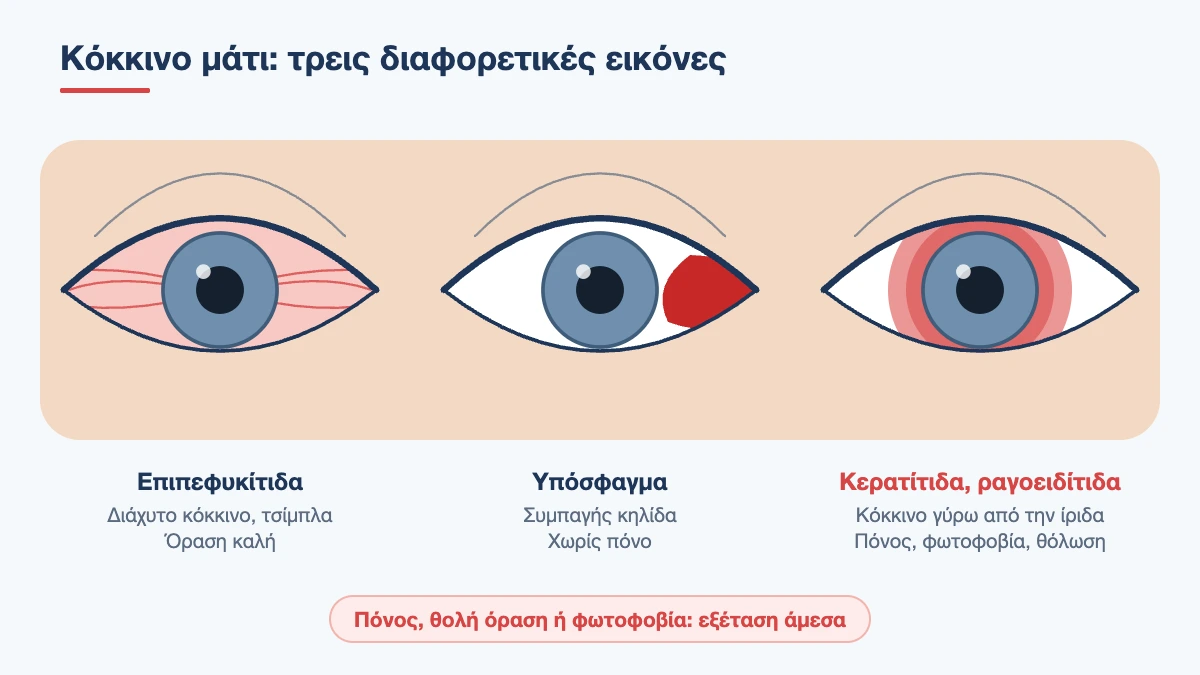
Viral conjunctivitis usually starts in one eye and spreads to the other within a few days, with a watery discharge, a gritty feeling and often a preceding cold. It is highly contagious. Bacterial conjunctivitis causes a thick, yellow-green discharge and eyelids that are stuck together in the morning. In both, vision remains good and there is no real pain. More detail on the page on conjunctivitis.
Blepharitis
Chronic inflammation of the eyelid margins keeps the eyes permanently slightly red, with crusts on the lashes, burning in the morning and often styes. It improves with daily eyelid hygiene, not with “whitening” eye drops.
Subconjunctival haemorrhage
A bright red, solid patch on the white of the eye that appeared suddenly, without pain and with normal vision, is almost always a subconjunctival haemorrhage: a small blood vessel has burst and the blood has spread under the conjunctiva. It looks alarming, but it is absorbed on its own within 1 to 3 weeks.
Pinguecula and pterygium
If the redness is always in the same spot, next to the coloured part of the eye on the side nearest the nose, around a small bump, there is probably a pinguecula or a pterygium that becomes inflamed after sun, wind or dust.
Irritation from external factors
Chlorine in the swimming pool, smoke, alcohol, dust, shampoo, a foreign body under the eyelid. The redness settles within a few hours once the cause is removed.
Causes that should not wait
Keratitis
Inflammation or infection of the cornea causes pain, sensitivity to light, watering and blurred vision, and the redness is more intense around the iris. The greatest risk is for contact lens wearers, especially if they have slept or swum in their lenses. Bacterial keratitis can leave a scar within two to three days.
Uveitis (iritis)
Inflammation inside the eye. It causes a deep, dull pain that gets stronger in light and when reading, a red ring around the iris, a small pupil and blurred vision, without discharge. It often recurs and may be linked to rheumatological conditions. See the page on eye inflammation.
Acute angle-closure glaucoma
A sudden, large rise in the pressure inside the eye. The eye becomes very red and hard, the pain is intense and spreads to the forehead, vision blurs, coloured haloes appear around lights and there is often nausea or vomiting, so much so that the patient thinks they have a stomach problem or a migraine. It is one of the few true emergencies in ophthalmology: without treatment within hours, the optic nerve suffers permanent damage. More on glaucoma.
Scleritis
Inflammation of the wall of the eye itself. The pain is deep and boring, worse at night and with eye movement, and the redness has a purplish tinge. It is often linked to autoimmune diseases and needs systemic treatment. Its milder relative, episcleritis, causes a red sector with slight tenderness and settles within a few days.
Herpes
Herpes in the eye usually affects one eye, with redness, watering, sensitivity to light and a foreign body sensation, and it tends to come back. Its importance is that steroids, which help in other types of inflammation, can cause serious damage here.
Injury and chemical burn
Any red eye after a blow, a penetrating object or contact with a chemical must be examined immediately. With a chemical burn, the first step is thorough rinsing with running water for at least 15 minutes, before anything else.
Quick guide: what the symptoms suggest
| What you feel | Most likely cause | How urgent |
|---|---|---|
| Itching in both eyes | Allergy | Routine appointment if it persists |
| Burning, worse in the afternoon | Dry eye | Routine appointment |
| Discharge, eyelids stuck together | Conjunctivitis | Within 1 to 2 days |
| Red patch with no other symptoms | Subconjunctival haemorrhage | Not urgent |
| Pain and contact lenses | Keratitis | Same day |
| Pain in light, blurred vision | Uveitis, keratitis | Same day |
| Severe pain, haloes, nausea | Acute glaucoma | Immediately |
When to worry
Ask for an examination the same day when a red eye comes with:
- pain, not just stinging or scratchiness
- blurred vision that does not clear with blinking
- marked sensitivity to light
- coloured rings around lights
- nausea, vomiting or a severe headache
- a white spot on the coloured part of the eye
- a pupil of a different size or shape from the other
- contact lens wear
- an injury or a chemical
- recent surgery or an injection in the eye
- blisters on the forehead or nose, which suggest shingles (herpes zoster)
You should also be examined if “simple” redness has not improved after a week, if it keeps coming back or if it affects a newborn baby.
What you can do yourself
- Preservative-free artificial tears, 4 to 6 times a day. They are safe whatever the cause and are often enough
- Cold compresses for the itching and swelling of allergy, warm compresses for blepharitis and styes
- Take out your contact lenses and wear glasses until it has completely cleared
- Do not rub your eyes. Rubbing releases histamine and makes the itching worse
- Breaks from the screen: every 20 minutes, look at something far away for 20 seconds and blink deliberately
- Hygiene: wash your hands often, use your own towel and pillowcase, and do not share cosmetics
- Throw away the eye make-up you were using when an infection started
Three mistakes we often see
- Drops that “whiten” the eye. Vasoconstrictor eye drops hide the redness for a few hours. With daily use the eye becomes dependent on them and goes redder once their effect wears off. They do not treat anything and can delay the diagnosis
- Steroids without a prescription. An eye drop that “worked last time” can dramatically worsen herpes or a contact lens infection, and with long-term use it causes glaucoma and cataract
- Chamomile and tea. They are not sterile, and chamomile is a common allergen. For rinsing, use single-dose vials of saline instead
How the diagnosis is made
In most cases a few minutes at the slit lamp are enough. We measure the vision and the eye pressure, examine the eyelids, the conjunctiva and the cornea with dye, and check whether there is inflammation inside the eye. Exactly where the redness is, whether there is discharge and of what kind, and how the pupil reacts give the diagnosis. Cultures or blood tests are needed only in persistent or recurrent cases.
Book an appointment
If your eyes often go red or the redness does not go away, an examination will find the cause and spare you from trial-and-error eye drops. For a red eye with pain, blurring or contact lenses, call so that we can see you straight away. The practice is in Neo Psychiko, Athens, telephone 210 677 0007.
Frequently Asked Questions about Red Eyes
Why do I have red eyes every morning?
The most common causes are blepharitis, dry eye and incomplete closure of the eyes during sleep. Air conditioning, fans, lack of sleep and alcohol all contribute. If it happens regularly, your eyelids and tears need to be checked.
Are red eyes contagious?
Only when they are caused by viral or bacterial conjunctivitis. In that case they spread through hands, towels and pillows. Allergy, dry eye, subconjunctival haemorrhage and inflammation inside the eye are not contagious.
Which eye drops should I use for a red eye?
Preservative-free artificial tears are safe in every case. Avoid eye drops that whiten the eye and never use steroid or antibiotic drops without an examination, because the right treatment depends on the cause.
When is a red eye an emergency?
When it comes with pain, blurred vision, marked sensitivity to light, haloes around lights, nausea or an injury, and always if you wear contact lenses. In these cases an examination is needed the same day.
Can stress or high blood pressure make the eyes red?
Stress and lack of sleep worsen dry eye and so cause redness. Blood pressure does not make the eyes diffusely red, but it can contribute to a blood vessel bursting and a subconjunctival haemorrhage appearing.
How many days do red eyes take to clear?
Simple irritation passes within hours. Viral conjunctivitis lasts 1 to 2 weeks, and a subconjunctival haemorrhage up to 3 weeks. If there is no improvement after a week, get examined.
Questions about your case?
Dr. Skouteris will examine you at his practice in Neo Psychiko and explain your options.

Ophthalmic surgeon trained at the John Radcliffe University Hospital in Oxford and Fellow of the European Board of Ophthalmology (FEBO).
Full profileRelated articles
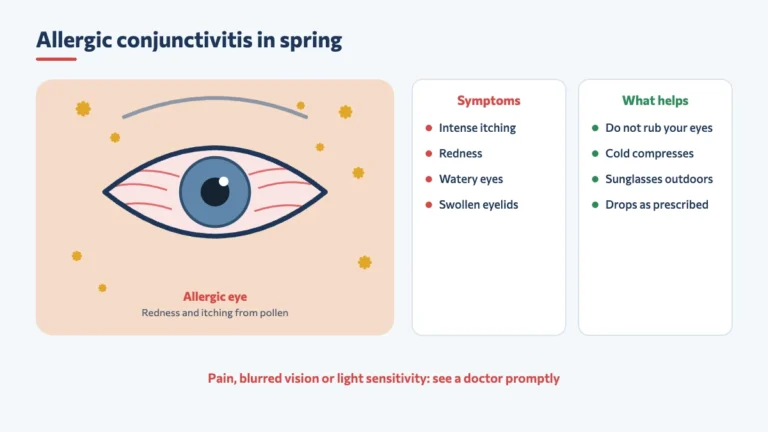
Allergic Conjunctivitis in Spring: Symptoms, Prevention and When to Worry
Itching, redness and watering in both eyes every spring? How to recognise allergic conjunctivitis, what helps prevent it and which signs need prompt examination.
Read the article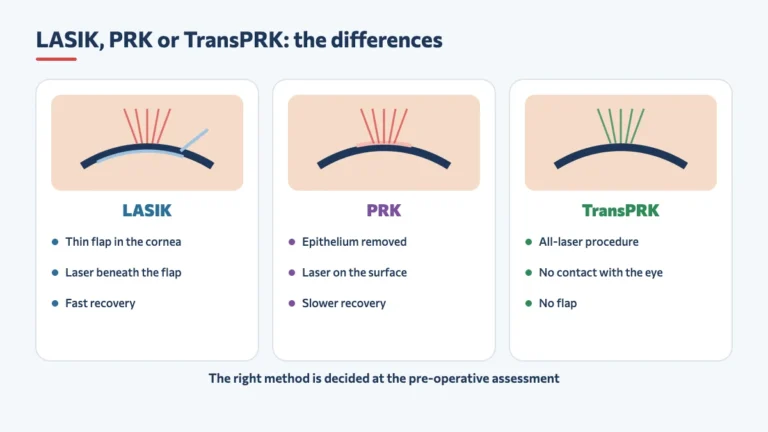
LASIK, PRK or TransPRK: Which Laser Eye Surgery Is Right for You?
The difference between LASIK, PRK and TransPRK, how long recovery takes and which criteria determine the right laser eye surgery for each eye.
Read the article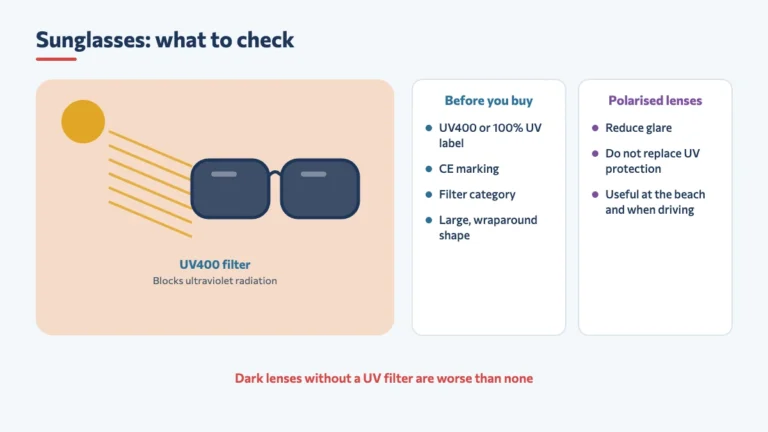
Sunglasses and Eye Protection: What to Check Before You Buy (Including for Children)
UV400, CE mark, filter category and polarised lenses: what to check before buying sunglasses for yourself and for your children.
Read the article