Page contents
- What do we mean by “blurred vision”?
- Blurred vision that develops gradually
- Sudden blurred vision: the urgent causes
- Blurring that comes and goes
- Blurred vision in children
- When to see an ophthalmologist or go to hospital straight away
- How the examination is done
- What you can do until you are examined
- Book an appointment
- Frequently Asked Questions about Blurred Vision
Blurred vision is one of the most common symptoms in ophthalmology, and it can mean anything from something very simple, such as glasses that need changing or dry eyes, to something urgent, such as retinal detachment or a stroke. The key is how it started. Blurring that develops slowly, over months, is examined at a routine appointment. Blurring that came on suddenly, within minutes or hours, needs an examination the same day.
What do we mean by “blurred vision”?
People use the same word for different things, and an accurate description helps a great deal with the diagnosis. Before your appointment, it is worth answering five questions:
- One eye or both? Close each eye in turn. Many people discover this way that the problem affects only one eye
- Sudden or gradual? Over minutes, days or months?
- Distance, near or everywhere?
- Constant, or does it come and go? Does it clear when you blink?
- What else is there? Pain, redness, flashes, floaters, distortion, double vision, headache?
Blurred vision that develops gradually
Refractive errors
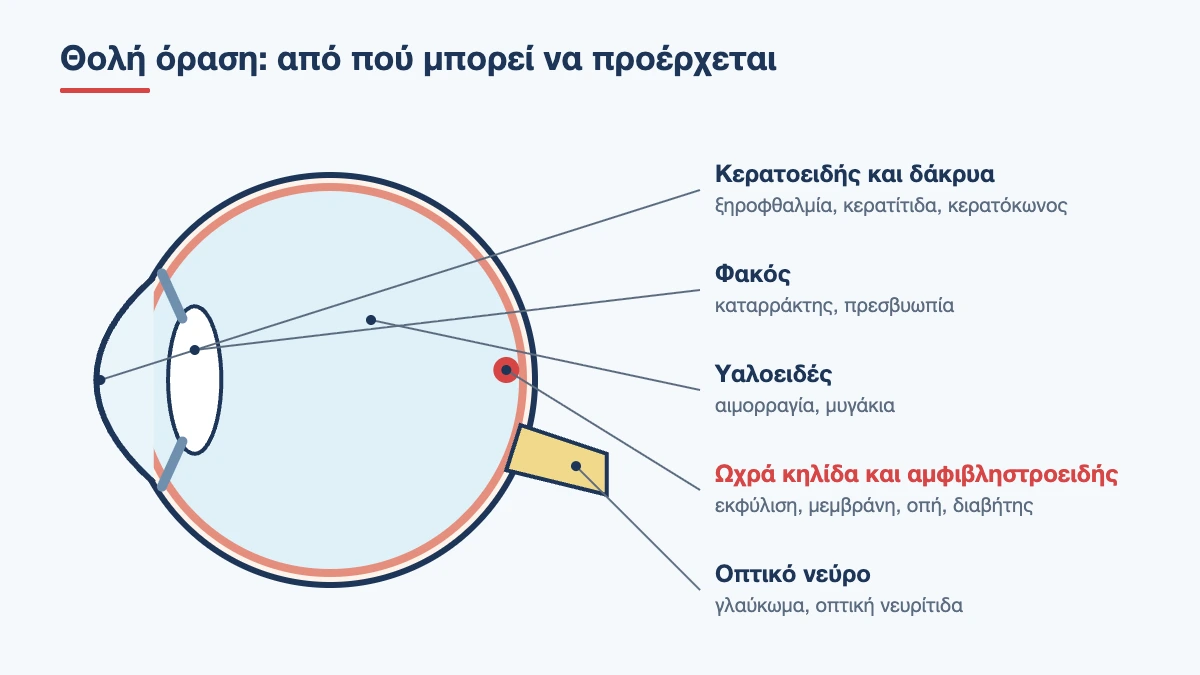
These are the most common cause at any age. In myopia (short-sightedness) distant objects are blurred, in hyperopia (long-sightedness) mainly near objects are blurred and the eyes get tired, and in astigmatism the image is hazy or has a “shadow” at all distances. After the age of 40 to 45, presbyopia is added: the text on your phone blurs and you hold it further and further away. All of these can be corrected with glasses, contact lenses or surgery.
Cataract
The natural lens of the eye becomes cloudy with age. Vision becomes hazy, as if you are looking through a dirty window, colours fade, car headlights at night cause glare and your glasses prescription changes often. It progresses slowly and painlessly. The treatment is cataract surgery.
Dry eye
It causes blurring that changes during the day: it gets worse when reading, at a screen and when driving, and clears briefly when you blink or use artificial tears. This fluctuation is its hallmark. It comes with burning and a gritty feeling. See the page on dry eye.
Macular conditions
When the centre of the image is blurred and straight lines look wavy, the problem is in the macula. The most common causes are age-related macular degeneration, epiretinal membrane, macular hole and diabetic macular oedema. The wet form of macular degeneration can worsen within days, which is why new distortion should not wait.
Diabetes
Diabetes blurs vision in two ways. Large swings in blood sugar temporarily change the shape of the lens, so your prescription fluctuates from day to day. Over time, diabetic retinopathy damages the blood vessels of the retina, often without symptoms in the early stages. Read how often you need an eye check.
Glaucoma
Chronic glaucoma does not blur vision at first. It silently destroys the peripheral visual field and is noticed late. This is why it is only detected through screening.
Keratoconus
In teenagers and young adults, blurring with rapidly increasing astigmatism and glasses that never quite work raises the suspicion of keratoconus.
Blurring after cataract surgery
Months or years after a successful operation, the membrane behind the intraocular lens can become cloudy and vision can become hazy again (posterior capsule opacification). The cataract does not come back. It is corrected permanently with a quick, painless laser treatment in the clinic.
Sudden blurred vision: the urgent causes
Retinal detachment and retinal tear
It is usually preceded by flashes and many new floaters, followed by a shadow or “curtain” that moves from the periphery towards the centre. It is not painful. Retinal detachment requires urgent surgery. It often starts with a posterior vitreous detachment that has torn the retina.
Retinal vessel occlusion
Central retinal artery occlusion causes sudden, painless, almost complete loss of vision in one eye and is treated like a stroke: immediate transfer to hospital. Retinal vein occlusion causes blurring that develops over hours or days and needs an examination within a few days.
Bleeding inside the eye
Sudden blurring with many dark spots, cobwebs or a reddish haze, more often in people with diabetes or after a posterior vitreous detachment.
Acute glaucoma
Blurred vision with severe pain, a red eye, coloured haloes around lights and nausea. The pressure must be lowered within hours.
Keratitis and uveitis
Blurring with pain, a red eye and sensitivity to light. Keratitis mainly affects contact lens wearers.
Optic neuritis
In young adults, blurring in one eye that worsens over a few days, with pain on eye movement and colours that look faded. More in the article on optic neuritis.
Stroke and transient ischaemic attack
Sudden loss of half of the image in both eyes, double vision, or vision that “goes dark” for a few minutes as if a blind is coming down, especially together with numbness, weakness in an arm or leg, a drooping mouth or difficulty speaking. Call 166 (the Greek ambulance service) immediately. Even if vision returns completely, the episode is a warning and needs to be checked the same day.
Giant cell arteritis
In people over 60: sudden loss of vision with headache at the temples, jaw pain when chewing, scalp tenderness and fatigue. Without immediate treatment, the second eye is also at risk.
Blurring that comes and goes
- Dry eye and screen fatigue: the most common cause, it clears with blinking
- Migraine visual aura: shimmering zigzag lines or a blurred spot that grows for 15 to 30 minutes and disappears, with or without headache. It is seen with both eyes
- Swings in blood sugar or blood pressure: blurring after a meal, or vision going dark when you stand up quickly
- Medicines: antihistamines, antidepressants, bladder medicines, steroids and others affect focusing or the tears
- Pregnancy: hormonal changes slightly alter the refraction. Blurring with headache and swelling in the third trimester needs an immediate blood pressure check
- Overwearing contact lenses: the cornea swells from lack of oxygen
Blurred vision in children
Children rarely say that they see blurred, because they do not know what clear vision looks like. They show it indirectly: they squint to see the board, sit very close to the television or the book, lose their place when reading, complain of headaches or avoid reading. The most common cause is an uncorrected refractive error, which, if it affects one eye more than the other, can lead to amblyopia (lazy eye). This is why the first full eye examination is recommended at 3 to 4 years of age and again before starting school, even if the child does not seem to have a problem. See the page on paediatric ophthalmology.
When to see an ophthalmologist or go to hospital straight away
- your vision has blurred or been lost suddenly, in one or both eyes
- you see a shadow, a curtain or a black area in your field of vision
- flashes or a shower of floaters have appeared
- straight lines have suddenly become wavy
- there is pain, a red eye or haloes
- you see double
- there is also headache, numbness, weakness or difficulty speaking
- there has been an injury or recent surgery on the eye
How the examination is done
The examination starts with measuring your vision and refraction, which shows whether the problem can be solved with glasses. This is followed by a slit lamp examination of the cornea, lens and tears, measurement of the eye pressure and a fundus examination with dilated pupils. Depending on the findings, optical coherence tomography (OCT) of the macula and optic nerve or visual field testing is carried out. In most cases the cause has been found by the end of the first visit. Bring your glasses and a list of your medicines and, because dilating drops will probably be used, do not drive.
What you can do until you are examined
For gradual, mild blurring with no other symptoms: use artificial tears, take frequent breaks from the screen, make sure you have good lighting for reading and check when you last changed your glasses. Do not keep buying ready-made reading glasses of increasing strength to “get by” for years without a check-up, because this delays the diagnosis of conditions that give no other signs. For sudden blurring there is nothing to try at home. Time is the only thing that matters.
Book an appointment
If your vision has become blurred and you do not know why, a comprehensive eye examination will give you an answer. For a sudden change in vision, call to be examined the same day. The practice is in Neo Psychiko, Athens, telephone 210 677 0007.
Frequently Asked Questions about Blurred Vision
Why has my vision suddenly become blurred?
Sudden blurring may be due to dryness or migraine, but also to retinal detachment, a blocked blood vessel, bleeding, acute glaucoma or a stroke. Because the serious causes cannot be told apart without an examination, any sudden change in vision should be checked the same day.
Can anxiety cause blurred vision?
Indirectly, yes. Anxiety and tiredness reduce blinking, worsen dry eye and make focusing harder, so vision blurs temporarily. However, anxiety is a diagnosis made only after eye-related causes have been ruled out.
Blurred vision in one eye: what does it mean?
It shows that the problem lies in the eye itself or its optic nerve, and not in your glasses or the brain. Common causes are cataract, macular conditions, dry eye and differences in prescription between the eyes. If it appeared suddenly, an immediate examination is needed.
Why is my vision blurred in the morning?
Usually because of dryness of the eye surface after sleep, blepharitis or eyes that do not close completely at night. If it clears within a few minutes of blinking, the cause lies in the tears. If it lasts for hours, the cornea needs to be checked.
Are blurred vision and dizziness together a cause for concern?
They may be due to migraine, low blood pressure, swings in blood sugar or the wrong glasses. However, if they appear suddenly together with double vision, unsteadiness, numbness or difficulty speaking, call 166 immediately.
Can blurred vision be corrected?
In most cases, yes: with glasses or laser for refractive errors, surgery for cataract, treatment of the tears for dry eye and injections for macular conditions. The earlier the diagnosis, the better the result.
Questions about your case?
Dr. Skouteris will examine you at his practice in Neo Psychiko and explain your options.

Ophthalmic surgeon trained at the John Radcliffe University Hospital in Oxford and Fellow of the European Board of Ophthalmology (FEBO).
Full profile