
Written by Vasileios Skouteris MD, FEBO, Ophthalmic Surgeon
Page contents
- What is blepharospasm?
- How common is it, and who does it affect?
- Causes of blepharospasm
- How it starts and how it progresses
- Blepharospasm or something else?
- Diagnosis
- Blepharospasm treatment
- What to expect at your first visit
- Living with blepharospasm
- When to book an appointment
- Frequently Asked Questions about Blepharospasm
Blepharospasm is the involuntary, repeated and forceful closing of the eyelids of both eyes, which the patient cannot control. It usually starts after the age of 50 with frequent blinking and sensitivity to light, and it can progress to spasms that keep the eyes shut for seconds or minutes, making reading, walking and driving difficult. It is not the harmless eyelid “twitch” caused by tiredness. It is a neurological movement disorder which cannot be cured permanently but can be controlled very well with botulinum toxin injections roughly every three months.
What is blepharospasm?
The eyelids close when a flat, circular muscle surrounding the eye contracts: the orbicularis oculi. Normally we blink 15 to 20 times a minute without thinking about it, and this rhythm is regulated by circuits deep inside the brain. In blepharospasm these circuits send faulty, excessive commands. The muscle contracts more often, more strongly and for longer than needed, and the patient cannot stop it at will.
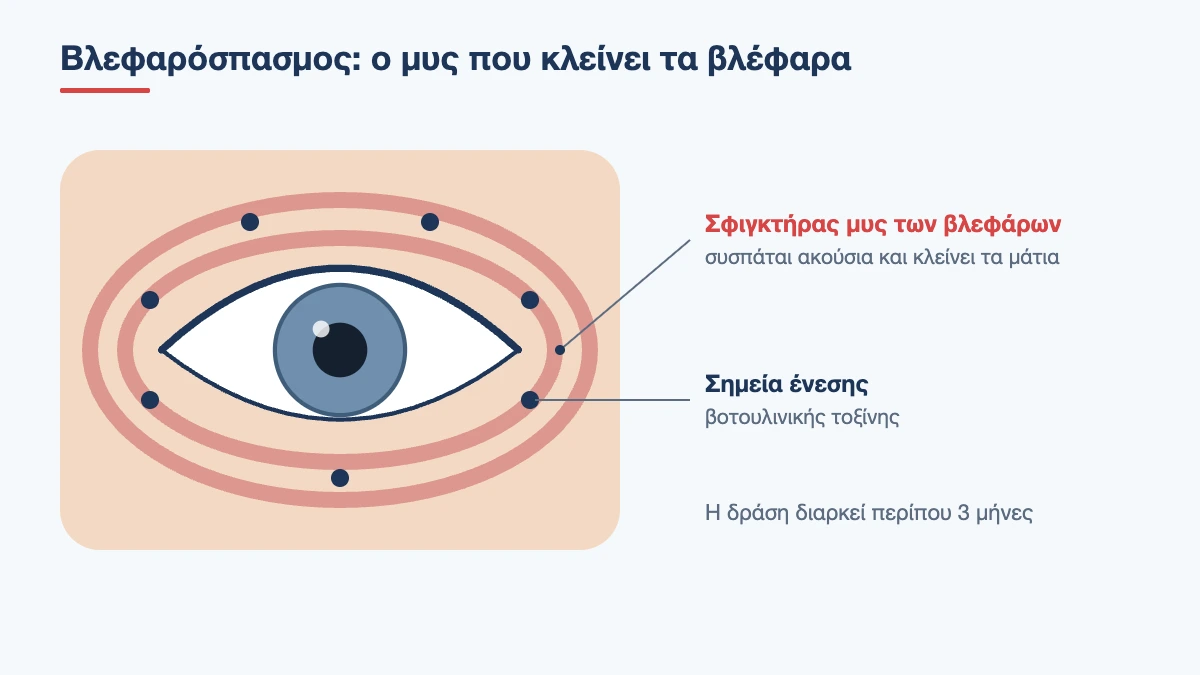
Medically, blepharospasm belongs to the focal dystonias, disorders in which a group of muscles contracts involuntarily, as happens with the neck muscles in cervical dystonia (torticollis) or with the hand in “writer’s cramp”. The full term is benign essential blepharospasm. “Benign” means that it is not life-threatening and is not caused by a tumour or a stroke. “Essential” means that the exact cause is not known. The eyes and vision are completely healthy. The problem is that the eyelids do not let the person use them, and in severe forms the patient is practically unable to see, despite having excellent vision.
How common is it, and who does it affect?
It is relatively rare: it is estimated to affect about 5 in every 100,000 people. It usually appears between the ages of 50 and 70, and women are affected two to three times more often than men. In a small number of patients another family member has blepharospasm or another dystonia, which points to a genetic predisposition. Because it is rare and starts insidiously, many patients spend months or years with diagnoses such as dry eye, allergy or anxiety before they find out what they have.
Book an appointment with the doctor
An examination and clear advice on your case at our practice in Neo Psychiko.
Causes of blepharospasm
Primary blepharospasm
The most widely accepted explanation is a malfunction in the basal ganglia, the brain centres that coordinate movement and “put the brakes” on it, and in the circuits that control the blink reflex. On CT and MRI scans the brain looks normal. The problem is functional rather than structural. It is thought that in people with a predisposition, a trigger such as a chronic condition of the eye surface or a period of intense stress sets off the disorder, which then becomes self-sustaining.
Secondary and reflex blepharospasm
- Irritation of the eye surface: severe dry eye, blepharitis, lashes rubbing against the eye, entropion, a foreign body, keratitis or inflammation inside the eye. Here the squeezing is a protective reaction and settles once the cause is treated
- Medicines: mainly antipsychotics and certain anti-sickness drugs after long-term use, as well as medicines for Parkinson’s disease
- Neurological diseases: Parkinson’s disease and related syndromes, and more rarely lesions in the brainstem
How it starts and how it progresses
The onset is almost always gradual. At first the patient notices that they blink more often, that light bothers them and that their eyes “sting” or “get tired”. At this stage the picture closely resembles dry eye, and the two conditions often coexist. Within months or a few years, frequent blinking becomes squeezing, and squeezing becomes prolonged spasm. In most people the condition worsens over the first few years and then stabilises. In about 1 in 10 there is spontaneous remission, usually within the first five years, but it may not be permanent.
Symptoms
- very frequent blinking
- involuntary, forceful squeezing of both eyes, lasting from seconds to minutes
- difficulty opening the eyes after a spasm
- marked sensitivity to light
- a feeling of dryness, burning or grittiness
- contractions in the eyebrows and forehead and, in some people, in the lower face, jaw or neck
- over the years, loose eyelid skin and drooping eyebrows from the constant contractions
What makes it worse and what relieves it
One of the most characteristic features of the condition is that it varies greatly depending on circumstances. The spasms get stronger with bright light, especially sunlight and car headlights at night, with wind, tiredness, stress, reading, watching television, driving and walking in crowds. They ease or disappear during sleep, when relaxing and when the patient concentrates on something else.
Many patients discover small “tricks” on their own that temporarily stop the spasm: they touch the eyebrow or temple, gently pull the eyelid, talk, sing, whistle, chew gum or yawn. These sensory tricks are typical of dystonias and help with the diagnosis. They also explain why in the clinic, where the patient is talking and concentrating, the spasm may be much milder than at home, which does not mean they are imagining it.
Blepharospasm or something else?
Not every eyelid contraction is blepharospasm, and telling them apart matters a great deal in practice.
| Condition | What we see | One or both eyes | Course |
|---|---|---|---|
| Eyelid myokymia (“twitching”) | A fine flicker in one spot on the eyelid, without the eye closing | One | Goes away on its own in days or weeks |
| Blepharospasm | Forceful, prolonged closing of the eyelids | Both, at the same time | Chronic, controlled with treatment |
| Hemifacial spasm | Contractions in the eyelid that spread to the cheek and the corner of the mouth | One side of the face | Chronic, continues during sleep |
| Tic | Quick, repetitive movements that can be suppressed for a short time | Varies | Often in childhood, usually settle |
| Reflex squeezing | Closing due to pain or irritation, with a red eye | Usually one | Settles once the cause is treated |
Myokymia is what most people mean when they say their “eye is twitching”. It is linked with tiredness, lack of sleep, stress and caffeine, is completely harmless and does not develop into blepharospasm. You will find it covered in detail in the article on eye and eyelid twitching.
Hemifacial spasm deserves special mention. It affects only one side, starts in the eyelid and over months or years spreads down to the cheek and mouth. It is usually caused by a blood vessel touching and irritating the facial nerve where it leaves the brain. That is why an MRI scan is requested for any spasm that affects only one side.
Finally, there is a condition that looks like blepharospasm but is not: apraxia of eyelid opening. The eyelids do not squeeze, they simply do not open, as if the command has “got stuck”. The patient raises their eyebrows and tries, without success, for a few seconds. It can coexist with blepharospasm and explains why some people do not respond fully to the usual treatment.
Diagnosis
The diagnosis is clinical. There is no blood test or scan that confirms it. It is based on the history and on observing the spasms, and the ophthalmologist is often the first doctor to make it. During the examination:
- we observe the blink rate and the pattern of the spasms at rest, while talking and in bright light. A mobile phone video, recorded at home during a bad moment, is very helpful
- we carefully examine the eye surface at the slit lamp, with dye and tear measurement, for dry eye, blepharitis, rubbing lashes or another cause of irritation
- we assess the position of the eyelids and eyebrows
- we check whether the contractions involve other facial muscles, and whether there is asymmetry
- we ask in detail about medicines, current and past
A brain MRI and a neurological assessment are requested when the spasm is one-sided, when it started at a young age, when it came on suddenly or when there are other neurological signs, such as tremor, stiffness, unsteadiness or speech problems.
Blepharospasm treatment
Blepharospasm cannot be cured permanently, but in the vast majority of patients it can be controlled to a degree that allows a normal life. Treatment has three parts: botulinum toxin, care of the eye surface and adjusting the conditions that trigger the spasms.
Botulinum toxin (Botox) injections
This has been the treatment of choice for more than thirty years. It is worth noting that blepharospasm was one of the first medical uses of botulinum toxin, long before it became known for its cosmetic use. The toxin temporarily blocks the transmission of the signal from the nerve to the muscle, so the orbicularis muscle relaxes.
The treatment is given in the clinic and takes a few minutes. Using a very fine needle, small injections are given under the skin at 4 to 8 points around each eye, on the eyelids, at the outer corner and, if needed, between the eyebrows. The sting is brief and tolerable. No anaesthetic or recovery time is needed, and you can return to your activities straight away.
- the effect begins in 2 to 5 days and peaks in 1 to 2 weeks
- it lasts 3 months on average, ranging from 2 to 4
- about 9 out of 10 patients improve significantly
- the injections are repeated when the spasms start to come back, and their effectiveness is maintained for decades
- the dose and injection points are adjusted from session to session, depending on how you responded the previous time. The first session is usually more conservative
Side effects are local and always temporary, as the effect of the medicine wears off:
- Drooping of the upper eyelid for 2 to 4 weeks, if the medicine spreads to the muscle that lifts it. This happens in a small proportion of sessions
- Incomplete eye closure and dryness, which are managed with artificial tears and ointment at night
- Watering, if the lower eyelid becomes lax
- A small bruise at the injection site
- Double vision, rarely, for a few weeks
To reduce spread, for the first few hours after the session do not rub the area, do not lie down and avoid strenuous exercise.
Care of the eye surface
Dry eye and blepharitis fuel the spasms, and the spasms in turn disrupt the tear film. Treating them is not enough on its own in primary blepharospasm, but it reduces the intensity of symptoms and improves the response to the injections. It includes preservative-free artificial tears, eyelid hygiene with warm compresses and, where needed, anti-inflammatory treatment or punctal plugs.
Glasses with a special tint
Photophobia is the most troublesome symptom for many patients. Lenses with a rose tint (FL-41) that filters specific wavelengths of blue-green light have been shown in studies to reduce the blink rate and the intensity of the spasms, and they can also be worn indoors. Outdoors, dark wraparound sunglasses and a peaked cap help. Constantly wearing very dark glasses indoors is not recommended, because the eyes adapt to the dark and sensitivity to light increases.
Oral medicines
Various medicines that act on the nervous system have been tried, such as muscle relaxants, anxiolytics and anticholinergics. The help they offer is moderate and inconsistent, and they often cause drowsiness, dizziness or a dry mouth, especially in older people. They are used as an add-on, in cooperation with a neurologist, when the injections are not enough or when the dystonia also affects other muscles.
Surgical treatment
This is reserved for the few patients who do not respond adequately to botulinum toxin. The main operation is partial removal of the orbicularis muscle of the eyelids (myectomy), often combined with correction of the ptosis, excess skin and drooping eyebrows caused by years of spasms. After surgery most people still need injections, but at lower doses and with a better result. In apraxia of eyelid opening, a frontalis sling, which suspends the eyelids from the forehead muscle, can help.
Book an appointment with the doctor
An examination and clear advice on your case at our practice in Neo Psychiko.
What to expect at your first visit
The first visit takes longer than a routine examination, because the history is the most important tool. It helps to have noted when the symptoms started, in what circumstances they get worse, what relieves them and which medicines you take or have taken in recent years. If you have one, bring a short mobile phone video and any previous test results. If the diagnosis is confirmed and you decide to start injections, the first session can often be done on the same day. A follow-up is scheduled after 2 to 3 weeks, when the effect is at its peak, to assess the result and adjust the dose for next time.
Living with blepharospasm
The condition affects much more than the eyes. Patients describe avoiding going out, being afraid to cross the road, and others thinking they are nervous or “winking”. Social isolation, anxiety and depression are common and deserve as much attention as the spasms. Some practical tips:
- Driving: if the spasms close your eyes even for a second, do not drive until they are controlled with treatment. Discuss this openly with your doctor
- Schedule your injections before the effect of the previous ones has completely worn off, so that you do not spend weeks with severe symptoms. A diary noting the day the spasms started to return helps find the right interval
- Sleep and routine: tiredness is one of the strongest triggers
- Lighting at home: choose indirect, warm light and reduce screen brightness
- Use the tricks that help you, such as touching your eyebrow or chewing gum, without embarrassment
- Tell the people around you. When family and colleagues know that this is a neurological condition and not nervousness, everyday life becomes easier
- Ask for psychological support if your mood has been affected. Stress does not cause blepharospasm, but it makes it noticeably worse
When to book an appointment
Get examined if you blink much more often than you used to, if your eyelids squeeze shut without you wanting them to, if you find it hard to keep your eyes open in light, or if an eyelid “twitch” lasts more than three weeks. Ask to be seen sooner if the contractions affect one side of the face and reach the cheek or mouth, or if they come with a drooping eyelid, double vision or weakness. At the clinic in Neo Psychiko, Athens, we first check the eye surface, which is the most common treatable cause, and plan the next steps with you. Call 210 677 0007 or use the contact form.
Do your eyelids squeeze shut on their own?
We start by checking the eye surface, the most common treatable cause. Book an appointment.
Frequently Asked Questions about Blepharospasm
Is blepharospasm the same as eye twitching?
No. Twitching, or myokymia, is a fine flickering in one eyelid caused by tiredness, stress or caffeine, and it goes away on its own. Blepharospasm is a forceful, involuntary closing of both eyes, it is chronic and it needs treatment. Myokymia does not develop into blepharospasm.
Can blepharospasm be cured permanently?
There is currently no permanent cure. However, botulinum toxin injections control the spasms in about 9 out of 10 patients and allow a normal daily life. In a small proportion of patients the condition settles spontaneously in the first few years.
How often are the injections needed?
The effect lasts 3 months on average, ranging from 2 to 4 depending on the patient. The injections are repeated when the spasms start to come back. Their effectiveness is maintained even after many years of treatment.
Is botulinum toxin safe around the eyelids?
Yes, it has been used for blepharospasm for decades. Side effects, such as a temporarily drooping eyelid, dryness or a small bruise, are local and resolve completely within a few weeks as the effect of the medicine wears off.
Is blepharospasm caused by stress?
No. It is a neurological movement disorder, not a psychological condition. Stress and tiredness make the spasms worse, as does bright light, but they do not cause them. That is why relaxation alone is not enough to make them go away.
Can it make me blind?
It does not damage the eyes or vision. In severe forms, however, the eyelids stay closed so often that the patient effectively cannot see, read or drive. With treatment, this ability to function is restored in most people.
My spasm is only on one side of my face. What does that mean?
It is most probably not blepharospasm but hemifacial spasm, which is usually caused by a blood vessel irritating the facial nerve. It needs an MRI scan and a neurological assessment. It is also treated with botulinum toxin or, in selected cases, with surgery.
Medically reviewed by: Dr. Vasileios Skouteris MD, FEBO