Page contents
Eye floaters are usually harmless, but they can sometimes be linked to a retinal tear. A retinal tear is a common condition, but it can have very unpleasant consequences if it is not treated appropriately.
What are eye floaters?
Let us start from the beginning. The inside of the eye is filled with a gel called the vitreous. Over the years, for various reasons, the vitreous body separates from the wall of the eye, a process known as posterior vitreous detachment. At this stage the patient notices floaters (the medical term is myodesopsia), small specks or black spots that suddenly appear in the field of vision. These are nothing more than parts of the vitreous that are less transparent and cast a shadow on the retina, which we see as floaters.
When are floaters dangerous?
However, the gel may remain attached at some point on the wall of the eye and pull on the retina, the tissue it is attached to. The symptoms then become more intense, and flashes or streaks of light usually appear in the field of vision.
What is a retinal tear?
At this point a fundus examination is essential, because if the traction is strong enough, the retina can tear, in other words a break can form. This can happen at the very moment the vitreous separates and the first symptoms appear, or later on if the flashes persist or the symptoms get worse. The tear is dangerous because it is an opening through which fluid can start to pass beneath the retina, gradually lifting it away, and eventually lead to retinal detachment.
How is a retinal tear treated?
This is why we intervene when we diagnose a tear, using a laser to surround the area around it. In other words, we perform laser photocoagulation, strengthening the bond between the retina and the underlying tissues, which greatly reduces the chance of the retina detaching. The procedure takes a few minutes, is painless and spares us many unpleasant consequences.
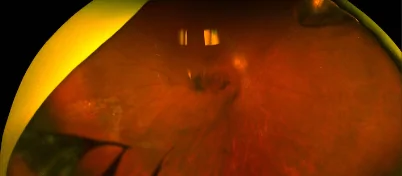
The photograph shows the fundus of one of Dr Skouteris’s patients who had a retinal tear, before and after laser treatment.
Find out more about fundus photography and how it helps with diagnosis and monitoring.
When should I see an ophthalmologist urgently?
Most floaters are harmless, but certain signs may mean a retinal tear or detachment and need examination on the same day or, at the latest, within 24 hours:
- sudden appearance of many new floaters, like a “cloud” or “shower” of dots,
- flashes of light (photopsia), mainly at the edge of the visual field or in the dark,
- a shadow or “curtain” covering part of your vision that does not go away,
- sudden blurring or loss of vision,
- floaters after a blow to the eye or the head.
The risk is higher in people with high myopia, in those who have had cataract surgery and in those with a history of detachment in the other eye or in the family. The examination is carried out with dilated pupils so that the whole periphery of the retina can be checked. A tear that is found early is usually treated with laser in the clinic, whereas retinal detachment requires surgery. If the floaters are old and do not change, it is enough to mention them at your next scheduled check-up.
Frequently Asked Questions about Eye Floaters
Are eye floaters dangerous?
In most cases floaters are harmless and are caused by normal changes in the vitreous with age or myopia. They become dangerous when they appear suddenly in large numbers or are accompanied by flashes or a shadow over your vision, as they may indicate a retinal tear or detachment that needs prompt examination.
Do eye floaters go away?
Floaters rarely disappear completely, but they usually become less bothersome within a few months. This is because they move away from the centre of vision and the brain learns to ignore them. In rare cases, when they seriously affect daily life, laser treatment or vitrectomy may be discussed.
When should I worry about floaters?
You need an examination on the same day if floaters appear suddenly in large numbers, if they come with flashes of light, a shadow or curtain in your field of vision or sudden blurring, and if they appear after a blow. People with high myopia or who have had cataract surgery should be especially careful.
Why do I see floaters when I look at the sky?
Floaters are small opacities in the vitreous that cast a shadow on the retina. They are more noticeable against a bright, uniform background, such as a blue sky, a white wall or a computer screen. If they are old and stable we are usually not concerned, but any sudden change needs an eye examination.
Questions about your case?
Dr. Skouteris will examine you at his practice in Neo Psychiko and explain your options.

Ophthalmic surgeon trained at the John Radcliffe University Hospital in Oxford and Fellow of the European Board of Ophthalmology (FEBO).
Full profileRelated articles
Diabetic Maculopathy (Diabetic Macular Oedema)
Diabetic macular oedema is one of the conditions that affect the macula, a term many people have heard of nowadays because of…
Read the article
Aftercare Instructions after an Intravitreal Injection
Please follow the aftercare instructions below after your intravitreal injection to avoid a possible infection or other serious complication from the injection:…
Read the article
Protecting Your Eyes in Summer: The 3 Most Common Mistakes
Proper summer eye protection from solar radiation is extremely important. It is widely known how beneficial the sun can be for our…
Read the article