Page contents
- What is keratoconus?
- Why is adolescence a critical period?
- Keratoconus symptoms to look out for
- Ordinary astigmatism or keratoconus?
- Eye rubbing and allergies
- Other risk factors
- How is keratoconus diagnosed?
- Corneal cross-linking: what it offers
- Everyday life for a teenager with keratoconus
- When to see an ophthalmologist
- Frequently Asked Questions about Keratoconus in Teenagers
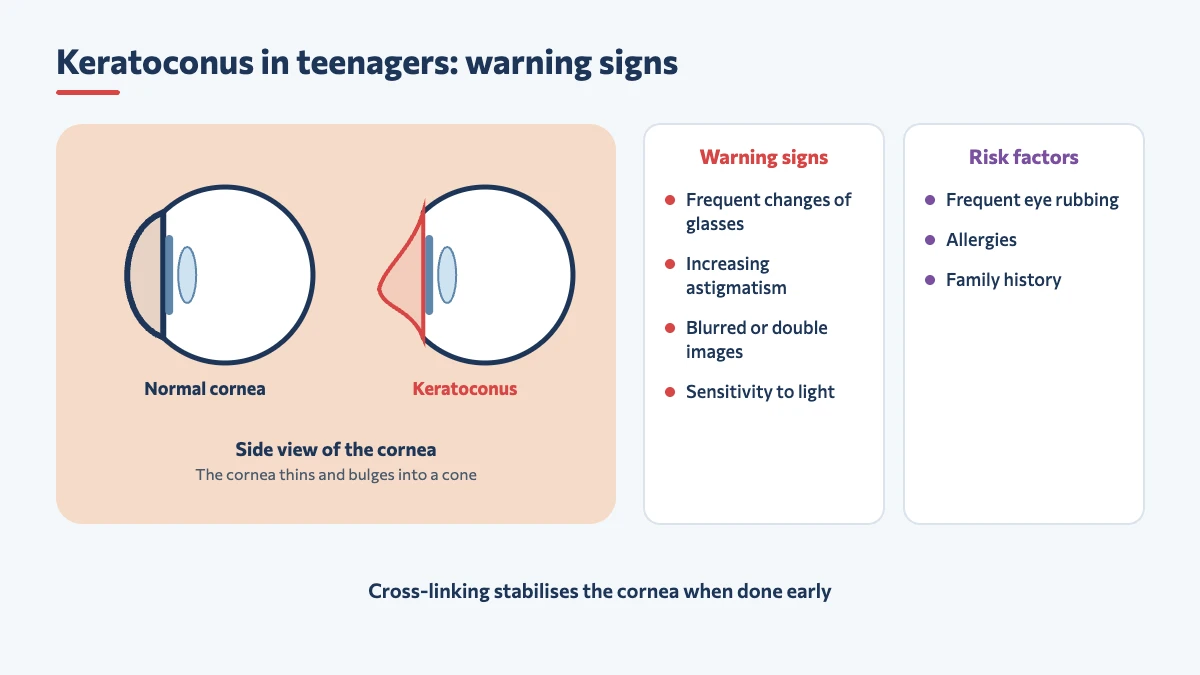
Keratoconus in teenagers usually shows up as blurred or distorted vision, frequent changes of glasses and astigmatism that increases quickly. Because the condition tends to progress faster at a young age, early diagnosis with corneal topography is very important for protecting vision.
What is keratoconus?
Keratoconus is a condition of the cornea, the clear “window” at the front of the eye. The cornea gradually thins and, instead of keeping its smooth dome shape, bulges forward like a cone. This irregular surface bends light in a distorted way, causing blurring, distortion of images and irregular astigmatism that cannot always be fully corrected with glasses.
The condition usually affects both eyes, though often to a different degree. It typically starts in adolescence or early adulthood and can progress for years, until around the age of 30 to 40. You will find detailed information on diagnosis and treatment on our page about keratoconus.
Why is adolescence a critical period?
In teenagers, keratoconus tends to progress faster and more aggressively than in adults. In addition, the first symptoms look very much like simple short-sightedness or astigmatism, so they are easily put down to “tiredness from studying” or screens. As a result, many children change glasses again and again without having had the right tests.
Early diagnosis matters, because there is now a treatment that can slow down or stop progression. The earlier it is carried out, the more vision is preserved.
Keratoconus symptoms to look out for
The symptoms of keratoconus develop gradually. Watch out if your teenager:
- needs new glasses very often, for example every few months,
- has astigmatism that increases or changes axis from one examination to the next,
- sees blurred or “double” with one eye, even with their glasses on,
- sees streaks or halos around lights, especially at night,
- is bothered by bright light,
- squints to read the board or subtitles,
- can no longer tolerate soft contact lenses or does not see well with them.
None of these on its own means keratoconus. However, a combination of them, or a rapid change in prescription, is a reason for more specialised testing.
Ordinary astigmatism or keratoconus?
| Feature | Ordinary myopia or astigmatism | Possible keratoconus |
|---|---|---|
| Prescription changes | Gradual, usually small | Frequent, with increasing astigmatism |
| Vision with glasses | Clear | Often not completely clear |
| Difference between the eyes | Usually small | Often significant |
| Lights at night | Usually normal | Streaks, halos, multiple images |
| Corneal topography | Smooth, symmetrical pattern | Localised bulging and thinning |
Eye rubbing and allergies
Vigorous and frequent eye rubbing is one of the most important risk factors that we can actually influence. The mechanical pressure appears to put extra strain on an already vulnerable cornea and to speed up progression. Many teenagers rub their eyes with their knuckles, for several seconds, without realising it.
Behind the rubbing there is often itching caused by allergy. Allergic conjunctivitis, asthma and atopic eczema are more common in children with keratoconus. Treating the allergy properly, with the help of an ophthalmologist, reduces the itching and therefore the urge to rub.
Practical tips for home:
- Explain to your child why they should not rub their eyes.
- When there is itching, cold compresses on the closed eyelids and lubricating drops kept in the fridge often bring relief.
- If your child rubs their eyes in their sleep, discuss it with the doctor.
- Treat seasonal allergies early.
Other risk factors
- Family history: if a parent or sibling has keratoconus, the other family members should be checked.
- Atopy: allergies, asthma, eczema.
- Certain syndromes, such as Down syndrome, and connective tissue disorders.
How is keratoconus diagnosed?
In the early stages, keratoconus may not be visible in a routine examination. The key test is corneal topography or tomography, which accurately maps the curvature and thickness of the cornea. It is quick, painless and does not involve touching the eye. Repeating it at regular intervals shows whether the condition is progressing, which determines treatment. In paediatric ophthalmology, the examination is adapted to the child’s age and level of cooperation.
Corneal cross-linking: what it offers
Corneal collagen cross-linking is the treatment that has changed the course of keratoconus in recent years. Riboflavin (vitamin B2) drops are applied to the cornea, followed by controlled ultraviolet light. This creates new bonds between the collagen fibres and makes the cornea stronger.
It is important to be precise about what it does:
- The aim is to slow down or stop progression. In most studies, the condition stabilises in a high proportion of patients.
- It does not “cure” keratoconus or restore the normal shape of the cornea. Afterwards, glasses or special contact lenses are usually still needed.
- There is some discomfort in the first few days, and vision settles gradually over a few months.
- Long-term follow-up is needed to confirm stabilisation.
In teenagers, because progression can be rapid, cross-linking is usually discussed early, as soon as progression has been documented. For vision, depending on the stage, glasses or special contact lenses, such as rigid gas permeable or scleral lenses, are used. LASIK laser refractive surgery is not suitable for eyes with keratoconus.
Everyday life for a teenager with keratoconus
A diagnosis often worries the family, but most teenagers with keratoconus carry on normally with school, sport and their activities. What changes is that they need regular monitoring, usually with topography every few months at first, and consistency in following instructions.
- In contact sports or ball games, protective eyewear reduces the risk of injury.
- Special contact lenses need proper hygiene and regular fitting checks.
- If vision is affecting school performance, it is worth telling the teacher so that the child can sit at the front.
When to see an ophthalmologist
Book a check-up if your teenager changes glasses often, does not see clearly even with their prescription, or if keratoconus runs in the family. Ask for an urgent examination in the event of a sudden drop in vision with pain, severe sensitivity to light or redness, and a white haze appearing in the eye, which may mean acute corneal oedema (hydrops).
If you are worried about your child’s vision, book an appointment at our clinic in Neo Psychiko, Athens, for a topography check.
Frequently Asked Questions about Keratoconus in Teenagers
At what age does keratoconus usually appear?
The first signs usually appear in adolescence or the early twenties, although less often the condition starts earlier. Progression often continues for several years and slows down after the age of 30 to 40. The younger the age at diagnosis, the closer the monitoring needed, because progression tends to be faster.
Can eye rubbing cause keratoconus?
Vigorous and frequent rubbing is considered an important risk factor, particularly in predisposed people, and appears to contribute to the progression of the condition. However, keratoconus also has a genetic basis, so it is not caused by rubbing alone. Stopping the rubbing and treating the allergy are among the most useful steps a family can take.
Will my teenager still need glasses after cross-linking?
Usually yes. Cross-linking aims to stabilise the cornea, not to correct the refractive error. In some patients the curvature improves slightly over time, but this is not the aim of the treatment. Vision continues to be corrected with glasses or special contact lenses, depending on the stage.
If one parent has keratoconus, should the children be checked?
Yes, this is recommended. Keratoconus is more common in first-degree relatives of patients, and the early stages do not always cause symptoms. Corneal topography in adolescence, repeated depending on the findings, allows diagnosis before vision is significantly affected and before valuable treatment time is lost.
Questions about your case?
Dr. Skouteris will examine you at his practice in Neo Psychiko and explain your options.

Ophthalmic surgeon trained at the John Radcliffe University Hospital in Oxford and Fellow of the European Board of Ophthalmology (FEBO).
Full profileRelated articles
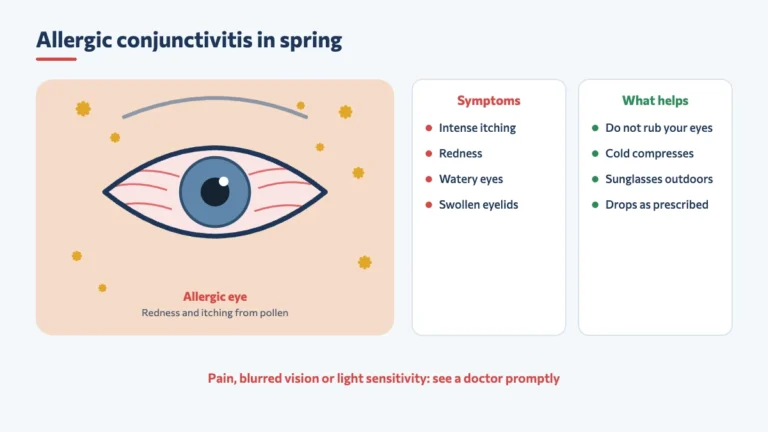
Allergic Conjunctivitis in Spring: Symptoms, Prevention and When to Worry
Itching, redness and watering in both eyes every spring? How to recognise allergic conjunctivitis, what helps prevent it and which signs need prompt examination.
Read the article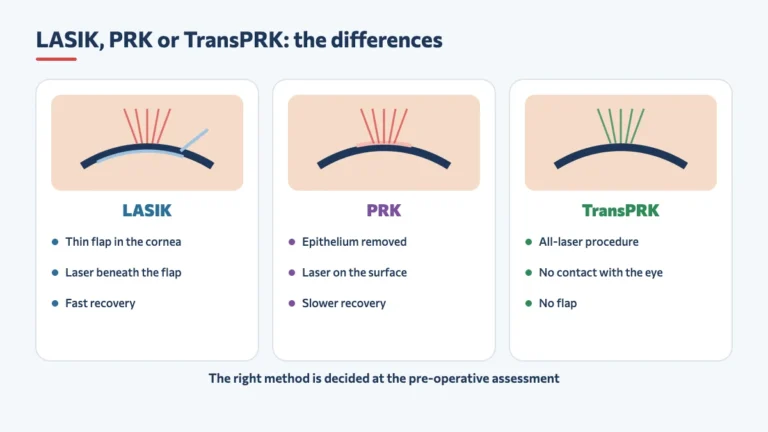
LASIK, PRK or TransPRK: Which Laser Eye Surgery Is Right for You?
The difference between LASIK, PRK and TransPRK, how long recovery takes and which criteria determine the right laser eye surgery for each eye.
Read the article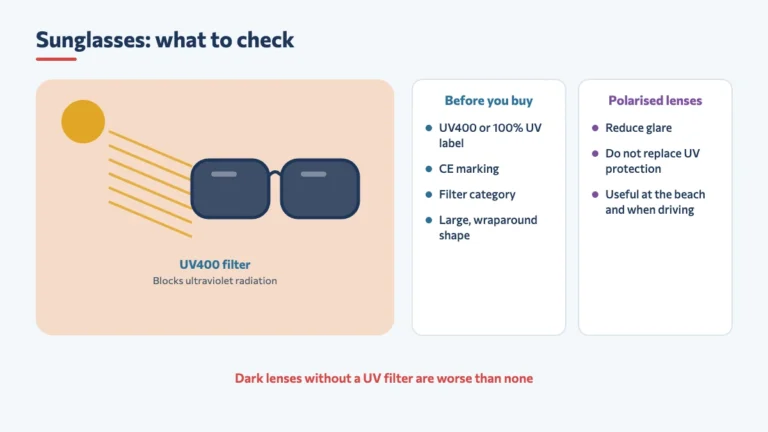
Sunglasses and Eye Protection: What to Check Before You Buy (Including for Children)
UV400, CE mark, filter category and polarised lenses: what to check before buying sunglasses for yourself and for your children.
Read the article